Used Panhans S45 All In One for sale (37,834)
Sort results
- Lowest price Highest price
- Newest listings Oldest listings
- Shortest distance Farthest distance
- Newest year of manufacture Oldest year of manufacture
- Latest update Oldest update
- Manufacturer A to Z Manufacturer Z to A
- Relevance
- Lowest price
- Price
- Highest price
- Price
- Newest listings
- Release date
- Oldest listings
- Release date
- Shortest distance
- Distance
- Farthest distance
- Distance
- Newest year of manufacture
- Year of construction
- Oldest year of manufacture
- Year of construction
- Latest update
- Update
- Oldest update
- Update
- Manufacturer A to Z
- Manufacturer
- Manufacturer Z to A
- Manufacturer
- designation from A to Z
- Description
- designation from Z to A
- Description
- Model from A to Z
- Model
- Model from Z to A
- Model
- Lowest reference
- Ref.No.
- Highest reference
- Ref.No.
- Shortest runtime
- Runtime
- Longest duration
- Runtime
- Relevance
- Relevance
Listing
Fumane (Verona)
6,710 km
Used KRONES Variopac Pro FS 45 shrink wrapper
KronesFS 45
Call
Condition: used, Year of construction: 2008, machine/vehicle number: FA70, Used KRONES Variopac Pro FS 45 shrink wrapperTechnical Specifications & Performance DataThe Krones Variopac Pro FS 45 is an automatic shrink wrapper designed for high-efficiency secondary packaging on a used bottling line. Built for industrial packaging environments, this second hand unit offers reliable performance for beverage production requiring robust bundle formation with shrink film. Manufactured by Krones, the FS 45 model supports PET bottle handling and delivers consistent throughput with a two-row grouping configuration.Manufacturer: KronesSeries: Variopac ProModel: FS 45Year: 2008Machine Category: Shrink WrapperOperating Mode: Film only (no tray)Production Speed: up to 45 cycles/min (two-row package handling) - 2.700 PPH Package Configurations: 4x3 for 0.5L PET (12 bottles per bundle); 2x3 for 1.5L PET (6 bottles per bundle)Container Types: PET bottlesFormat Range: 0.5L and 1.5L bundlesAdvanced Automation & Control SystemsThe FS 45 integrates automatic grouping and film application optimized for consistent shrink wrapping results. Its control architecture supports stable operation, precise timing, and synchronized infeed to maintain target throughput. Operator-friendly controls facilitate start-up, stop, and routine adjustments, while status indication and fault messaging streamline production oversight. Quick mechanical adjustments help reduce changeover time between supported pack patterns.Production Line Integration CapabilitiesEngineered for seamless integration, the Variopac Pro FS 45 interfaces smoothly with upstream and downstream bottling equipment on PET lines. It is suitable for stand-alone operation or as part of a complete packaging system, connecting with conveyors for continuous flow. The machine’s two-row grouping supports common beverage pack patterns such as 4x3 for 0.5L and 2x3 for 1.5L PET bottles, enabling flexible secondary packaging layouts for various SKUs in beverage production and industrial packaging environments.Machine Condition & Maintenance HistoryThis unit is presented as ready for operation, well-suited for deployment in a second hand used bottling line. The robust Krones engineering of the Variopac Pro series is known for durability and maintainability, supporting ongoing performance with routine service practices typical of high-volume packaging machinery.Operational Performance & VersatilityOptimized for PET containers, the FS 45 delivers stable bundle formation for beverage production lines. Its film-only configuration eliminates the need for trays, reducing material usage while maintaining transport stability after shrink. The two-row grouping design helps achieve the specified cycles per minute with common pack matrices. This shrink wrapper is a strong fit for industrial packaging operations handling high-volume SKUs, supporting applications across water, juice, CSD, beer, and other beverage segments where PET bundling is standard.Installation Requirements & Site PreparationThe Krones Variopac Pro FS 45 is intended fo...
Hfjdpfx Aoziy Droflsi
Listing
Zheng Zhou Shi
3,684 km
Crushing equipment
Stone crushing production lineStone crushing screening plant
Call
Condition: new, functionality: fully functional, Year of construction: 2026, A stone crushing plant for sand and aggregate making is a facility where stones and rocks are crushed into smaller pieces or gravel. It typically includes several stages of crushing and screening to produce various sizes and grades of sand and aggregate materials, which are essential in construction, landscaping, and other applications. Here's an introduction to the components and processes involved in a typical stone crushing plant:
### Components of a Stone Crushing Plant
1. Primary Crusher:
- Purpose: The primary crusher, often a jaw crusher or gyratory crusher, initially breaks down large rocks into smaller pieces.
- Function: It handles raw materials from the quarry or mine and prepares them for further processing.
2. Secondary Crusher:
- Purpose: A secondary crusher, such as a cone crusher or impact crusher, further reduces the size of the crushed stones.
- Function: It refines the material after primary crushing, producing smaller and more uniform-sized aggregates.
3. Tertiary Crusher (Optional):
- Purpose: In some configurations, a tertiary crusher like a vertical shaft impactor (VSI) may be used for shaping and fine crushing.
- Function: It produces finely crushed materials for specific applications, such as concrete production or road base.
4. Screening Equipment:
- Purpose: Screening equipment like vibrating screens or trommel screens separates the crushed materials into different sizes.
- Function: It classifies the aggregates into various grades according to size, ensuring uniformity and meeting specifications.
5. Conveyor Systems:
- Purpose: Conveyor belts transport materials between different stages of crushing and screening.
- Function: They ensure efficient material handling and continuous operation within the plant.
6. Washing Equipment (Optional):
- Purpose: Washing equipment, such as sand washers or scrubbers, may be used to remove impurities from sand and aggregate products.
- Function: It improves the quality of the final products by cleaning them and removing fines or contaminants.
### Processes Involved
Hjdsq N U Dujpfx Afljfi
- Primary Crushing: Large rocks are fed into the primary crusher and reduced to a manageable size.
- Secondary Crushing: The crushed materials from the primary crusher are further processed by secondary crushers to achieve the desired aggregate sizes.
- Screening: The crushed and sized materials are screened to separate them into different sizes and grades.
- Material Handling: Conveyor systems transport materials between different stages of the crushing and screening process.
Final Product Handling:Finished products, such as sand and various sizes of aggregates, are stored or loaded for transport to customers or construction sites.
Applications
- Construction: Used in the production of concrete, asphalt, and road base materials.
- Landscaping: Provides decorative and functional aggregates for gardens, pathways, and driveways.
infrastructure: Essential for building foundations, drainage systems, and structural fill.
As for the capacity we have 30 t/h, 30-50 t/h, 50-100 t/h, 100-150 t/h, 150-200 t/h, 200-300 t/h, 300-500 t/h, and both stationary crushing plant and mobile crushing plant are available for option.
Listing
Hörsching
6,472 km
Open semitrailer with tarp
KRONESD 24 TAUTLINER, BPW-ACHSEN, LIFTACHSE, EDSCHA-VERDECK,
Call
Condition: used, empty load weight: 6,676 kg, maximum load weight: 26,324 kg, overall weight: 33,000 kg, axle configuration: 3 axles, first registration: 08/2017, suspension: air, tire size: 385/65 R22.5, Equipment: ABS, | Kögel SD24 Tautliner | BPW axles with disc brakes | Lift axle | Toolbox | Spare wheel holder | Tires: 385/65 R22.5 | Austrian vehicle | Subject to errors, input errors and prior sale.
Hodpfx Afozhtf Tolefi

Get information now
+44 20 806 810 84
+44 20 806 810 84
List now
*per listing / month
Listing
Heteren
7,086 km
Reefer semitrailer
KRONESDR Cool Liner FP 60 ThermoKing SLXi 300
Call
Condition: used, functionality: fully functional, maximum load weight: 27,000 kg, overall weight: 8,806 kg, axle configuration: 3 axles, first registration: 03/2021, total length: 14,040 mm, total width: 2,600 mm, suspension: air, color: white, Year of construction: 2021, Equipment: cooling unit, full service history, power assisted steering, Technical specifications
Cooling unit Thermo King SLX i 300-50, Diesel/Electric, included i-Box, with data recording (CargoWa
KRONE axles with air suspension and disc brakes
Tyres Information
Front left - 5 mm
Hfjdezkudijpfx Aflji
Front right - 5 mm
Middle left - 5 mm
Middle right - 5 mm
Rear left - 5 mm
Rear right - 5 mm
Listing
Vuren
7,135 km
Refrigerated/frozen transport
KRONESD MEATRAILS THERMOKING
Call
Condition: used, axle configuration: 3 axles, first registration: 06/2010, loading space length: 13,590 mm, loading space width: 2,470 mm, loading space height: 2,590 mm, total length: 14,100 mm, total width: 2,600 mm, total height: 4,000 mm, suspension: air, tire size: 385/65R22,5, wheelbase: 8,860 mm, color: other, Year of construction: 2010, Equipment: ABS, = Additional Options and Accessories =
- EBS
= Notes =
Number of axles: 3, Payload: 32040 kg, Tare weight: 8960 kg, Gross vehicle weight: 41000 kg, Chassis type: Full chassis, Kingpin size: 2 inch, Suspension type: Full air suspension, ABS, EBS, Body construction year: 2010, Refrigeration unit manufacturer: Thermoking, Refrigeration unit model: Slx400, Refrigeration unit: Diesel/electric, Unit hours / electric: 5123, Unit hours / Diesel: 9044, Wall thickness: 50 mm, Coupling, Type of cooling: Refrigeration, Axle type: SAF, MEAT RAILS THERMO KING SLX 400
= Additional Information =
General Information
Cab: Day cab
License plate: OL-17-BK
Powertrain
Fuel type: Diesel
Transmission
Gearbox: Manual transmission
Axle Configuration
Tire size: 385/65R22.5
Brakes: Disc brakes
Suspension: Air suspension
Axle 1: Tire tread depth left: 10 mm; Tire tread depth right: 9 mm
Axle 2: Tire tread depth left: 12 mm; Tire tread depth right: 11 mm
Axle 3: Tire tread depth left: 9 mm; Tire tread depth right: 12 mm
Weights
Tare weight: 8,960 kg
Payload: 32,040 kg
GVW: 41,000 kg
Functional
Refrigeration unit: Diesel and electric (9044 operating hours diesel; 5123 electric)
Wall thickness: 50 mm
Environmental
Emission class: Euro 0
Condition
Overall condition: fair
Technical condition: fair
Optical condition: fair
Damage: none
= Company Information =
Kleyn Trucks is one of the world's largest independent dealers in used vehicles. Here you can choose from a constantly changing stock of 1200 used trucks, tractor units, and trailers. Our range includes all European brands from various years of manufacture and price ranges.
Hsdpfx Afjzkrhfeljfi
Why buy from Kleyn Trucks? Simple!
• Large, rapidly changing stock
• Recognizable quality
• A good price
• Proper business practices
• We speak many languages
• We understand our customers
• Assistance with import and transport
• (Export) registration can be arranged quickly
• Expert technical services
• The security of "recognizable quality"
• And more....
Please visit our website for special offers and a complete inventory:
Leasing through Kleyn Trucks is possible in most European countries!
Quickly calculate your leasing rate and submit an inquiry through our website.
Ask directly about our European warranty package.
Listing
Borken
7,009 km
With equipment package P Plus
Testschrank für Lithium - IonenEnergiespeicher BINDER KB 720
Call
Condition: excellent (used), Year of construction: 2022, Binder
BINDER KB 720 Refrigerated Incubator with P Plus Package
– Battery Test Chamber EUCAR 5, CO₂ Extinguishing System
Device Description:
For sale is a BINDER KB 720 (E6) refrigerated incubator, year of manufacture 2022, equipped with the extended safety and performance test package “P Plus”.
This unit is not a regular laboratory incubator, but a high-quality safety test chamber, specifically developed for aging, performance, and safety tests of lithium-ion energy storage systems.
Special Added Value:
The unit is designed to reliably detect, monitor, and safely contain critical battery events – up to EUCAR Hazard Level 5 (fire/flames, but no explosion).
Device Capabilities (Section 2 – Performance & Application):
- Aging tests on lithium-ion cells
- Performance tests (charge/discharge cycles under controlled temperature)
- Temperature endurance and thermal cycling tests
- Testing of both unpowered and cycled cells
- Reproducible, precise temperature control throughout the usable chamber
- Safe testing under realistic thermal conditions
- Test environment for R&D, automotive, e-mobility, and energy storage applications
Suitable for:
- Battery and cell manufacturers
Hfodpszizr Rjfx Aflji
- Research and development laboratories
- Test laboratories & safety assessments
- Automotive / E-mobility / Energy storage sectors
P Plus Package turns the KB 720 into a dedicated battery safety test cabinet:
Integrated Safety Features:
- Automatic & manual CO₂ fire suppression system
- Smoke detector with optical & acoustic alarm
- Mechanical double-door locking (secure containment)
- Spark protection in the chamber
- Exhaust port with reversible overpressure flap
- Ports for external inertization (e.g., nitrogen)
- Emergency stop / manual triggering of suppression system
- Access ports for charging and measurement cables
Result:
The unit is designed for testing lithium-ion cells up to EUCAR Hazard Level 5, where fire or flames may occur without explosion or uncontrolled propagation. It is not an abuse or destruction test device, but rather a safe, standard-compliant chamber for real-world operating and fault scenarios.
Technical Data:
- Temperature range: –10°C to +100°C
- Interior volume: approx. 698 liters
- Shelves: 4 × stainless steel
- Max. load per shelf: 45 kg
- Max. total load: 100 kg
Electrical Data:
- Power supply: 200–240 V AC
- Frequency: 50 / 60 Hz
- Phase: single-phase
- Power consumption: approx. 2.1 kW
- Fuse rating: 16 A
- Refrigerant: R134a
- Protection class: IP 20
Dimensions & Weight:
- External (W × H × D): approx. 1250 × 1950 × 900 mm
- Internal (W × H × D): approx. 970 × 1250 × 576 mm
In summary – What makes this device special:
- True battery safety test chamber
- EUCAR Hazard Level 5 compliant
- Integrated CO₂ suppression system
- Large chamber (≈700 l)
- High market and resale value
- Weight: approx. 285–300 kg
Condition: used
Scope of delivery: (see picture)
(Subject to technical changes and errors. All details without obligation!)
For further questions, we are happy to assist you by phone.
Listing
Vuren
7,135 km
Refrigerated/frozen transport
KRONESD THERMOKING SLXE 200
Call
Condition: used, axle configuration: 3 axles, first registration: 02/2015, loading space length: 13,400 mm, loading space width: 2,490 mm, loading space height: 2,650 mm, total length: 14,100 mm, total width: 2,600 mm, total height: 4,000 mm, suspension: air, tire size: 385/65R22,5, color: other, Year of construction: 2015, Equipment: ABS, = Additional options and equipment =
- EBS
= Remarks =
Number of axles: 3, Kerb weight: 8,610 kg, Gross weight: 41,000 kg, Kingpin size: 2 inch, Suspension type: air suspension, ABS, EBS, Body build year: 2015, Sidewall material: insulated, Refrigeration unit manufacturer: Thermoking, Refrigeration unit model: SLXe 200, Refrigeration unit: diesel, Unit hours / diesel: 11,774, Wall thickness: 45 mm, Cooling type: Cooling and freezing, Axle type: BPW
= Further information =
General information
Cab: Day cab
Registration number: KLEYN1
Drivetrain
Fuel type: Diesel
Transmission
Gearbox: Manual
Axle configuration
Tyre size: 385/65R22.5
Brakes: Drum brakes
Suspension: Air suspension
Axle 1: Tyre tread left: 8 mm; Tyre tread right: 8 mm
Axle 2: Tyre tread left: 6 mm; Tyre tread right: 7 mm
Axle 3: Tyre tread left: 6 mm; Tyre tread right: 5 mm
Weights
Unladen weight: 8,610 kg
Payload: 32,390 kg
Gross vehicle weight: 41,000 kg
Hfodpfsw Srxnox Aflsi
Functional
Refrigeration unit: Diesel (11,774 operating hours)
Wall thickness: 45 mm
Environment
Emission class: Euro 0
Condition
Overall condition: average
Technical condition: average
Visual condition: average
Damage: none
= Company information =
Kleyn Trucks is one of the world's largest independent used vehicle dealers. Here you can choose from a constantly changing stock of 1,200 used trucks, tractors and trailers. Our range covers all European makes, model years and price categories.
Why buy from Kleyn Trucks? Simple!
• Large, fast-changing inventory
• Recognizable quality
• Good prices
• Professional service
• We speak many languages
• We understand our customers
• Assistance with import and transport
• (Export) license plates arranged quickly
• Expert technical services
• The safety of “recognizable quality”
• And much more…
Please visit our website for special offers and our complete inventory:
Leasing via Kleyn Trucks is possible in most European countries!
Quickly calculate your leasing rate and submit an enquiry through our website.
Ask directly about our European warranty package.
Listing
Vilnius
5,861 km
Reefer semitrailer
KRONESDR Cool Liner FP 45 ThermoKing SLXi 300
Call
Condition: used, functionality: fully functional, maximum load weight: 27,000 kg, overall weight: 8,806 kg, axle configuration: 3 axles, first registration: 08/2023, total length: 13,400 mm, total width: 2,460 mm, suspension: air, color: white, Year of construction: 2023, Equipment: cooling unit, full service history, power assisted steering, Technical specifications
FP 45 SMART.
Cooling unit Thermo King SLX i 300-50, Diesel/Electric,. including installation and connection of th
Container type double rear doors, 3 piece aluminium hinges on each door half; quick replacement doo
Tool box, PVC, left side behind the axles, dimensions approx. 650x490x450 mm.
Fuel tank plastic, for approximately 240 ltr., tank opening on both sides, cover with cylinder lock.
Tyres - 6 x 385/65 R22.5.
Internal length: 13311mm. Internal width: approx. 2490mm. Internal height: 2650mm. Total height (unl
Pallet box for 36 Euro-pallets.
Chassis MB 7350 NOVA GREY SDGL. Axles including hub RAL 9005 JET BLACK.
Ventilation flap, at the front wall, at top of left side. Ventilation flap, at rear, left side at to
Hedpfx Aszc Nlyeflofi
spare wheel 385/65 R22.5.
Listing
Gdańsk
6,259 km
3d printer
INONE3DFGF 800 3D Printer
Call
Condition: new, functionality: fully functional, Year of construction: 2025, total length: 1,200 mm, total height: 1,550 mm, total width: 1,138 mm, overall weight: 350 kg, input voltage: 220 V, nozzle diameter: 3 mm, feed length X-axis: 800 mm, feed length Y-axis: 800 mm, feed length Z-axis: 800 mm, power: 5 kW (6.80 HP), space requirement length: 1,200 mm, space requirement height: 1,550 mm, space requirement width: 1,138 mm, Equipment: compressor, INONE3D FGF800 (WXF-FGF800) – Industrial Fully Enclosed FGF 3D Printer
The INONE3D FGF800 is a next-generation industrial 3D printer for 2025, developed for Fused Granulate Fabrication (FGF) and designed to provide cost-effective, large-format printing directly from plastic granules. This solution is ideal for manufacturing large prototypes, technical components, molds, and functional parts where reduced material costs and high productivity are key.
The machine features a fully enclosed housing, which improves process reliability, increases operator safety, and ensures a more stable printing environment. With a generous 800 × 800 × 800 mm build volume, support for 1–5 mm plastic granules, and interchangeable nozzles (0.6–3.0 mm), the FGF800 is suitable for both high-speed, large-volume production as well as applications requiring higher detail.
Technical Specifications:
- Printing Technology: Fused Granulate Fabrication (FGF)
- Model: WXF-FGF800
- Build Volume: 800 × 800 × 800 mm
- Nozzle Diameter: 0.6–3.0 mm
- Granule Size: 1–5 mm
Hjdpfxeyv Edao Aflefi
- Maximum Power Consumption: 5 kW
- Power Supply: 220 V
- Net Weight: 350 kg
- Machine Dimensions: 1200 × 1138 × 1550 mm
- Year of Manufacture: 2025
- Warranty: 12 months
- Design: Fully enclosed industrial 3D printer
- Availability: 2 units in stock
Listing
Zheng Zhou Shi
3,684 km
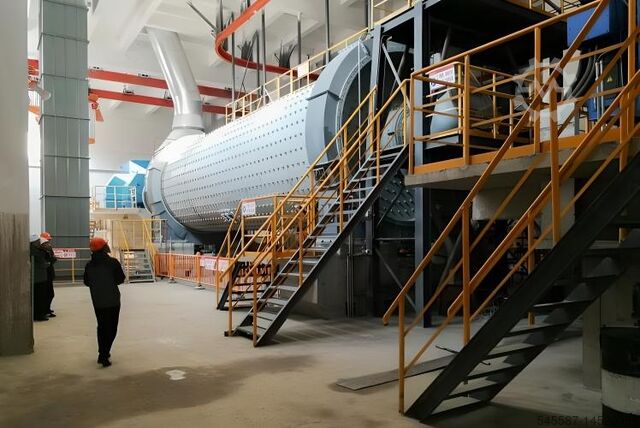
Ball mill for powder and mining plant
Mingyuan Ball Mill For Fine PowderPowder grinding mill for coal, silica
Call
Condition: new, functionality: fully functional, power: 55 kW (74.78 HP), Year of construction: 2026, Ball Mill for Powder and Mining Plant: Structure, Function, and Technical Details
A ball mill is a key grinding machine widely used in mining, metallurgy, cement, chemical, and powder-making industries. It is designed to grind various ores and other materials into fine powder through impact and attrition between steel balls and the material inside a rotating cylindrical shell. In mining plants, ball mills are essential for ore beneficiation, preparing materials for flotation, magnetic separation, or leaching processes. In powder production, they ensure uniform particle size and high surface area for further processing.
Working Principle
The ball mill operates on a simple yet effective principle: as the cylindrical shell rotates around its horizontal axis, the grinding media (steel or ceramic balls) are lifted along the inner wall by centrifugal force and friction. When they reach a certain height, they fall freely, striking and grinding the material below. This repeated motion causes both impact and abrasion, reducing the material to the desired fineness. The grinding process can be performed in dry or wet conditions depending on the application.
Structural Composition
A standard ball mill consists of several main components:
Feeding part: Equipped with a feeder or screw conveyor to ensure uniform material input.
Discharging part: Can be grate type or overflow type, depending on the discharge method.
Rotating part: The cylindrical shell made of steel plates, lined with wear-resistant liners.
Transmission system: Includes motor, reducer, small transmission gear, and electrical control.
Grinding media: Steel balls or ceramic balls of different diameters for efficient grinding.
The internal liner design and ball size distribution are optimized to achieve maximum grinding efficiency and minimal energy consumption.
Technical Details
Typical Specifications:
Feeding size: ≤25 mm
Discharge size: 0.074–0.4 mm
Capacity: 0.65–615 t/h (depending on model and material hardness)
Cylinder speed: 18–38 r/min
Power: 18.5–4500 kW
Liner material: High manganese steel, rubber, or alloy steel
Grinding media load: 30–45% of cylinder volume
Operating Modes:
Dry grinding: Suitable for materials that must remain moisture-free, such as cement clinker, limestone, and quartz.
Wet grinding: Common in ore beneficiation, where water or slurry improves grinding efficiency and particle uniformity.
Application in Mining Plants
In mining operations, ball mills are used after crushing to further reduce ore size and liberate valuable minerals. They are integrated into grinding circuits with classifiers, hydrocyclones, and flotation systems. The ground material is classified by size, and oversized particles are returned to the mill for regrinding. This closed-circuit system ensures consistent product fineness and efficient energy use.
Common Applications:
Gold, copper, iron, and zinc ore grinding
Cement clinker and slag processing
Silicate and ceramic powder production
Hfodoq Nf U Espfx Aflei
Coal and mineral powder preparation
Conclusion
A ball mill is an indispensable piece of equipment in both powder production and mining beneficiation plants. Its ability to grind materials into fine, uniform particles makes it vital for downstream processes such as flotation, sintering, and chemical reactions.
Listing
Cluj-Napoca
5,743 km
Cogeneration gas microturbine
CapstoneC65 microturbine
Call
Year of construction: 2017, condition: used, 65 kw microturbine gas generator
Hfsdpfszh Entjx Aflsi
Listing
Zheng Zhou Shi
3,684 km
Crushing equipment
Spring & Hydraulic cone crusherSpring & Compound&Hydraulic cone crusher
Call
Condition: new, functionality: fully functional, fuel type: electric, Year of construction: 2026, Spring & Hydraulic Cone Crusher: Design, Operation, and Technical Insights
Cone crushers are vital in mining, metallurgy, and aggregate production, designed for secondary and tertiary crushing of hard and medium-hard materials. Among the most common types are the spring cone crusher and the hydraulic cone crusher, each offering distinct advantages in structure, performance, and control.
Spring Cone Crusher
The spring cone crusher is a traditional design that uses mechanical spring systems for overload protection. When uncrushable material enters the crushing chamber, the spring mechanism allows the bowl liner to move downward, preventing damage to the crusher. Once the foreign object passes, the springs restore the original position, ensuring continuous operation.
Structural Composition:
Main frame and base assembly
Eccentric shaft and transmission system
Fixed and moving cones (mantle and concave)
Spring and adjustment mechanism
Working Principle:
Material is fed into the crushing chamber and compressed between the mantle and concave. The laminated crushing principle ensures that particles are crushed by both impact and pressure, producing uniform and well-shaped aggregates.
Technical Highlights:
Feed size: ≤300 mm
Discharge size: 3–60 mm
Capacity: 30–700 t/h
Motor power: 75–400 kW
Hodpfx Afetxhybjlefi
Advantages: Simple structure, low maintenance cost, stable performance, and reliable overload protection.
Applications:
Widely used in crushing granite, basalt, iron ore, copper ore, and limestone. It is suitable for medium-scale operations where cost efficiency and durability are priorities.
Hydraulic Cone Crusher
The hydraulic cone crusher is an advanced evolution of the spring design, integrating hydraulic systems for improved automation, safety, and precision. It replaces the mechanical spring system with hydraulic cylinders that control the discharge opening and provide overload protection.
Structural Composition:
Main frame and eccentric assembly
Hydraulic cylinders and control system
Crushing chamber with optimized liner design
Automatic lubrication and hydraulic adjustment units
Working Principle:
The hydraulic system adjusts the discharge opening and releases pressure automatically when uncrushable material enters. This prevents mechanical damage and allows the crusher to resume operation quickly. The combination of high-speed eccentric motion and optimized chamber geometry enhances crushing efficiency and product quality.
Technical Highlights:
Feed size: ≤320 mm
Discharge size: 3–50 mm
Capacity: 45–1200 t/h
Motor power: 90–630 kW
Advantages: Automatic cavity cleaning, precise control, high crushing ratio, and superior particle shape.
Applications:
Ideal for large-scale mining, aggregate production, and high-demand crushing lines requiring consistent output and minimal downtime.
Comparative Overview
Both crushers operate on the same compression principle but differ in control and automation. The spring cone crusher offers simplicity and cost-effectiveness, making it suitable for stable working conditions. The hydraulic cone crusher provides advanced control, faster adjustment, and higher efficiency, ideal for modern, large-capacity plants.
Listing
Zheng Zhou Shi
3,684 km
Mill / grinding mill
Batch Ball Mill, Silica grinding millQuartz ball mill, silica powder grinding
Call
Year of construction: 2026, condition: new, ceramic ball mill ,Batch ball mill ,also called ceramic ball mill ,it is used for fine grinding of feldspar,quartz,clay,ore and so on.The ceramic ball mill is mainly used for material mixing, grinding,uniform product fineness,and saving power.It can be dry or wet.The machine can use different liner types according to production needs to meet different needs.The fineness of the grinding operation is controlled by the grinding time
ceramic ball mill Working principle
when ball mill working,steel balls inside drum will rotate with the drum to some height,and then steel balls fall down with materials to reach the point of grinding.
Working Principle of Ceramic ball mill
ceramic ball mill ,Intermittent ball mill grinding operation is finished in the cylinder body. When the cylinder rotates, materials ascend to a certain height and then fall along a certain path due to the balls' gravity. Two forces are generated on the balls inside. One is the force on balls through tangent direction; the other is a opposite force in the contrast to the diameter of balls, as a result of the force generated when the balls slide down. These two forces will constitute a couple for the steel balls. The balls are squeezed between the cylinder and the adjacent steel balls, so the couple can make unequal-sized friction force. The balls will orbit along with the cylinder axis and then fall down, which can produce a strong impact force on the ores in the cylinder body and, as a result, the ores will be crushed. In conclusion, the ores in the cylinder body are mainly crushed by composite effect of peeling force, impact force and extrusion force.
Hfodpfjvzx Ausx Aflei
Ceramic ball mill also named Intermittent ball mill which adopts the wet intermittent operation, is used for fine grinding and mixing the material such as feldspar, quartz, clay ceramic raw materials. The discharging and the mud size can through through 1000 sieve pore. This machine is high milling machinery, materials should be Broken in the fineness of the state into the grinding mill to get the highest efficiency and economic benefits.
The cement mill is key equipment for the grinding process of the cement clinker after the crushing process of it. It is mainly used in the cement silicate product industry. After long term design and manufacture of the cement mill, our company now has series of cement mill with various specifications to meet with different requirement from our customers.
Features of Cement Mill
Our company adopts suitable transmission methods according to different specifications. We have brim drive and center drive as transmission form. The cylinder adopts new type step lining to increase the grinding area. And it is easily repairable and changeable. The new designed separate-chambered structure adopts flexible lifting blade and fixed lifting blade and it is easily fixed and repaired.
Technical Details
We have different models and options for different requirements, please contact us for more info.
Listing
Zheng Zhou Shi
3,684 km
Crushing equipment
Mingyuan Stone & rock impact crusherImpact crusher for sand gravel crushing
Call
Condition: new, functionality: fully functional, power: 75 kW (101.97 HP), Year of construction: 2025, Impact Crusher: Structure, Operation, and Technical Specifications
An impact crusher is a high-efficiency crushing machine widely used in mining, cement, construction, and recycling industries. It is designed to crush materials by utilizing the energy of impact rather than pressure, making it ideal for medium-hard and soft materials such as limestone, gypsum, coal, and concrete aggregates. Its ability to produce uniform, cubic-shaped particles makes it a preferred choice for aggregate production and fine crushing applications.
Working Principle
The impact crusher operates on a simple yet powerful principle: material is fed into the crushing chamber and struck by high-speed rotating blow bars mounted on a rotor. The kinetic energy from the rotor transfers to the material, causing it to break upon collision with the impact plates (also known as breaker plates). The crushed material rebounds within the chamber for secondary impacts until it reaches the desired size and exits through the discharge opening.
The process involves:
Primary Impact: Material is hit by blow bars and thrown against the impact plates.
Secondary Impact: Rebounded fragments collide again with the rotor or other particles, achieving finer crushing and better shape.
Structural Composition
An impact crusher consists of several key components that ensure efficient operation and durability:
Rotor Assembly: The core component, equipped with blow bars that deliver high-speed impact energy.
Impact Plates (Aprons): Adjustable plates that control the crushing gap and final product size.
Feed Inlet and Discharge Outlet: Designed for smooth material flow and uniform discharge.
Frame and Housing: Heavy-duty welded structure providing stability and vibration resistance.
Adjusting Device: Hydraulic or mechanical system for controlling the gap between rotor and impact plates.
Safety Mechanism: Hydraulic opening system for easy maintenance and overload protection.
Technical Highlights
Feed size: ≤500 mm
Hodpov E Ddlefx Aflofi
Discharge size: 0–60 mm (adjustable)
Capacity: 30–800 t/h
Motor power: 45–560 kW
Rotor speed: 500–1500 rpm
Performance Features:
High Crushing Efficiency: The high-speed rotor and optimized chamber design ensure strong impact force and high reduction ratio.
Excellent Particle Shape: Produces cubic, uniform aggregates suitable for concrete and asphalt production.
Adjustable Output Size: Hydraulic or mechanical adjustment allows precise control of product size.
Easy Maintenance: Replaceable blow bars and liners with quick access doors simplify servicing.
Versatile Applications: Suitable for primary, secondary, and tertiary crushing in various industries.
Types of Impact Crushers
Horizontal Shaft Impact (HSI) Crusher:
Uses a horizontal rotor to deliver impact energy. Ideal for soft to medium-hard materials and widely used in aggregate and recycling applications.
Conclusion
The impact crusher combines high-speed impact energy with a robust structural design to deliver efficient, reliable, and versatile crushing performance. Its ability to produce well-shaped aggregates, adjustable output sizes, and low maintenance requirements make it indispensable in modern crushing systems. Whether in mining, construction, or recycling, the impact crusher remains a key machine for achieving high productivity and superior material quality.
Listing
Zheng Zhou Shi
3,684 km
Glass grinding machine
Henan Mingyuan Ceramic /Silica Ball MillBatch ball mill for glass ceramic making
Call
Condition: new, Year of construction: 2026, power: 7.5 kW (10.20 HP), Batch ball mills find applications in various industries where the processing of materials in discrete batches is required. The versatility of batch ball mills makes them suitable for a range of applications. Here are some common batch ball mill applications:
1. Ceramics Industry:
- *Glaze Preparation:* Batch ball mills are extensively used in the ceramics industry for preparing glazes. Raw materials such as feldspar, quartz, and clay are ground with ceramic balls to achieve the desired particle size for glaze formulation.
2. Chemical Industry:
- *Material Grinding:* Batch ball mills are used for grinding and blending various chemical materials. This includes the production of pigments, dyes, and other specialty chemicals where precise particle size control is crucial.
3. Pharmaceuticals:
- *Drug Formulation:* In pharmaceutical manufacturing, batch ball mills are used for grinding and blending powders to create drug formulations. The controlled environment provided by these mills is essential for maintaining the integrity of pharmaceutical compounds.
Hfjdeq I N H Njpfx Afloi
4. Food Industry:
- *Ingredient Mixing:* Batch ball mills may find application in the food industry for mixing and grinding ingredients. This can include the production of food additives, flavorings, and other powdered or granular products.
5. Mining and Minerals Processing:
- *Ore Grinding:* Batch ball mills are used in mining and minerals processing for grinding minerals and ores. The controlled grinding helps in obtaining the desired particle size for subsequent processes, such as mineral separation or extraction.
6. Paints and Coatings:
- *Pigment Dispersion:* In the paints and coatings industry, batch ball mills are employed for dispersing pigments into paint formulations. Achieving a uniform particle size is crucial for the quality and appearance of the final coating.
7. Building Materials:
- *Raw Material Grinding:* Batch ball mills are used in the preparation of raw materials for the production of building materials, such as cement and concrete. Grinding of materials like limestone and clay helps in obtaining the desired fineness for subsequent processes.
8. Electronic Materials:
- *Ceramic Powder Processing:* In the electronics industry, batch ball mills can be employed for processing ceramic powders used in the production of electronic components and insulating materials.
9. Research and Development:
- *Material Testing:* Batch ball mills are often used in research and development laboratories for testing and optimizing material formulations. They provide a controlled environment for small-scale processing and experimentation.
10. Customized Applications:
- *Specialized Processes:* Batch ball mills can be adapted for various specialized processes in different industries where precise grinding and mixing are required. Custom modifications can be made based on specific application requirements.
When using a batch ball mill, it's important to consider factors such as the type of material being processed, desired particle size, and the specific requirements of the end product. Additionally, following the manufacturer's guidelines and maintaining proper operating conditions are essential for efficient and effective milling processes.
Technical details
We have different options for different requirements, please contact our team for more info.
Listing
Zheng Zhou Shi
3,684 km
Cement mill,clinker grinding plant
Clinker grinding mill / cement ball millcement grinding with air classifier
Call
Year of construction: 2026, condition: new, functionality: fully functional, A cement clinker grinding mill is a specialized equipment used to grind the hard nodular clinker into fine powder, which is cement. Most cement is currently ground in ball mills and also vertical roller mills, which are more effective than ball mills.
Here are key features and information about cement clinker grinding mills:
1. Raw Materials:
- The main raw material for making cement is clinker, which is produced by sintering limestone and clay. Other materials such as gypsum, fly ash, or slag may also be added during the grinding process to achieve specific properties.
2. Grinding Process:
- The clinker and other additives are finely ground in the grinding mill to produce cement. The grinding process is a crucial step in cement production and contributes significantly to the final quality of the product.
3. Types of Mills:
- Ball Mills: Traditional ball mills are commonly used for grinding clinker. They operate by rotating a cylinder with steel grinding balls, causing the balls to fall back into the cylinder and onto the material to be ground.
- Vertical Roller Mills (VRM): VRM technology has become increasingly popular for clinker grinding. These mills use a rotating table with rollers to crush and grind the clinker, providing energy efficiency and a smaller footprint compared to ball mills.
4. Gypsum Addition:
- Gypsum is often added during the grinding process to control the setting time of the cement. It prevents flash setting of the clinker and facilitates the formation of a workable and pumpable cement paste.
5. Quality Control:
- Quality control measures, such as monitoring the fineness of the cement, chemical composition, and other properties, are implemented during the grinding process to ensure the final product meets the required specifications and standards.
6. Clinker Cooling:
- Before grinding, the clinker is produced by heating the raw materials in a kiln. The clinker is then cooled before entering the grinding mill to prevent excessive heat build-up during grinding.
7. Dust Collection and Environmental Considerations:
- Dust collectors and air pollution control systems are often employed to capture and control the dust generated during the grinding process, addressing environmental and safety concerns.
8. Packaging and Storage:
- After grinding, the cement is typically stored in silos before being packaged in bags or dispatched in bulk for distribution to construction sites or for sale in the market.
Hedpfx Aeq Nfbhjflsfi
Cement clinker grinding mills play a crucial role in the cement production process, and advancements in technology continue to improve the efficiency and environmental sustainability of the grinding process.
Technical details
We have different options for different requirements, please contact our team for more info.
Listing
Zheng Zhou Shi
3,684 km
Powder grinding mill
ball mill for mining &fine powder makingsilica/Barite/limestone powder plant
Call
Condition: new, Year of construction: 2026, power: 300 kW (407.89 HP), Ball Mill for Mining & Fine Powder Making:
A ball mill is a fundamental grinding device widely used in mining, metallurgy, cement, and chemical industries. It is designed to grind ores and other materials into fine powder through impact and attrition between steel balls and the material inside a rotating cylindrical shell. In mining plants, ball mills are essential for ore beneficiation, while in powder-making industries, they ensure uniform particle size and high surface area for further processing.
Working Principle
The ball mill operates on the principle of impact and friction. As the cylindrical shell rotates around its horizontal axis, the grinding media—usually steel or ceramic balls—are lifted along the inner wall by centrifugal force and friction. When they reach a certain height, they fall freely, striking and grinding the material below. This repeated motion breaks down the material into fine particles. The process can be carried out in dry or wet conditions depending on the application.
Structural Composition
A standard ball mill consists of several main components:
Feeding part: Ensures uniform material input through a feeder or screw conveyor.
Discharging part: Can be grate type or overflow type, depending on the discharge method.
Rotating part: The cylindrical shell made of steel plates, lined with wear-resistant liners.
Transmission system: Includes motor, reducer, small transmission gear, and electrical control.
Grinding media: Steel or ceramic balls of various diameters for efficient grinding.
The internal liner design and ball size distribution are optimized to achieve maximum grinding efficiency and minimal energy consumption.
Technical Details/Typical Specifications:
Feeding size: ≤25 mm
Discharge size: 0.074–0.4 mm
Capacity: 0.65–615 t/h (depending on model and material hardness)
Hedpsq Ngafefx Aflofi
Cylinder speed: 18–38 r/min
Power: 18.5–4500 kW
Liner material: High manganese steel, rubber, or alloy steel
Grinding media load: 30–45% of cylinder volume
Operating Modes:
Dry grinding: Used for materials that must remain moisture-free, such as cement clinker, limestone, and quartz.
Wet grinding: Common in ore beneficiation, where water or slurry improves grinding efficiency and particle uniformity.
Application in Mining and Powder Production
In mining operations, ball mills are used after crushing to further reduce ore size and liberate valuable minerals. They are integrated into grinding circuits with classifiers, hydrocyclones, and flotation systems. The ground material is classified by size, and oversized particles are returned to the mill for regrinding. This closed-circuit system ensures consistent product fineness and efficient energy use.
In fine powder production, ball mills are used to produce materials such as silicate, ceramic powder, refractory materials, and chemical raw materials. The uniform particle size achieved by ball milling enhances product quality and performance in downstream applications.
Conclusion
A ball mill is an indispensable piece of equipment for both mining and fine powder making. Its ability to grind materials into fine, uniform particles makes it vital for ore beneficiation and industrial powder production. With flexible configurations, high efficiency, and reliable operation, modern ball mills provide a cost-effective and energy-efficient solution for large-scale grinding, ensuring consistent quality and productivity across diverse applications.
Listing
Zheng Zhou Shi
3,684 km
Roll forming line
Rod ball mill / Rod Grinding MillFor Sand and mining beneficiation plant
Call
Condition: new, Year of construction: 2026, We have various kinds of ball grinding mill such as batch ball mill, rod mill, cement ball mill, mining ball mill, welcome to contact our team for further details according to your specific requirements.
Hjdpfx Afeq I Nw Ioljfi
Listing
Großkarolinenfeld
6,624 km
Swap chassis trailer
KroneBDF Lafette 235/75R17,5 Zwilling BPW
Call
Condition: good (used), empty load weight: 2,830 kg, maximum load weight: 15,170 kg, overall weight: 18,000 kg, axle configuration: 2 axles, first registration: 03/2021, next inspection (TÜV): 02/2027, suspension: air, tire size: 235/75R17,5, Equipment: ABS, GERMAN DEALER offers:
BDF demountable semi-trailer
Twin tires
235/75R17.5
Hfodpfx Afozlt Trsloi
BPW axles
Ride height 990 mm
Drawbar adjustable in length
Multiple units available
#####
PLEASE CALL - NO EMAILS!
#####
DELIVERY POSSIBLE THROUGHOUT GERMANY!
MEPO COMMERCIAL VEHICLES HAS BEEN PROVIDING VEHICLES SINCE 1983!
INSPECTIONS ONLY BY APPOINTMENT!
#####
Listing
Zheng Zhou Shi
3,684 km
Construction debris/waste recycling line
jaw cone crusher plant 30-300 tphConstruction & Demolition Recycling Line
Call
Condition: new, Year of construction: 2026, functionality: fully functional, power: 75 kW (101.97 HP), Jaw crusher for stone & ore crushing in quarry and mining fields
Model: PE600X900
Max input size: 500mm
Capacity: 80-135 t/h
Motor: 75KW
Weight: 15T
Besides this models, we also have the other models like PE900X1200, PE500X750, PE250X400, PE400X600, etc, and we also have impact crusher, cone crusher, hammer crusher, vsi crusher, more important we can also provide complete stone crushing screening plant with capacity 30-1000 t/h, welcome to contact us for more details if you want a different model or the other type of crushing machine.
You can leave us a message if you need a different model or a different type of crusher.
Hfsdpfx Afeq H Shcslei
Listing
Menslage
6,942 km
Krones KES 2-4-312/25-110 Bottle Washer (2004)
KronesFlaschenreinigungsmaschine
Call
Condition: used, Year of construction: 2004, OVERVIEW
This Krones KES-2-4-312/25-110 bottle washing machine is designed for the industrial washing of returnable glass bottles in beverage production lines. The machine is equipped with 25 bottles per row and has a rated capacity of up to approx. 28,000 bottles per hour.
The machine can process bottle formats from 300 ml up to 1,000 ml, making it suitable for breweries, mineral water producers, soft drink producers and other returnable bottle operations. The washing machine is mainly built in stainless steel, with an insulated stainless steel caustic bath and steam heating system.
The machine will be delivered completely reconditioned. The reconditioning scope includes the bottle infeed and outfeed, heating system, pumps, main chain, valves, piping, spray nozzles, label removal station and electrical panel. A test run is also included.
The machine is offered with Siemens S7 PLC control and is available as a reconditioned machine at a special price.
Hodpjy Ul N Hjfx Aflsfi
TECHNICAL DATA
- Manufacturer: Krones
- Type: KES-2-4-312/25-110
- Machine Type: Bottle washing machine
- Year of Manufacture: 2004
- Capacity: approx. 28,000 bottles/hour
- Bottle Rows: 25 bottles per row
- Bottle Formats: approx. 300 ml up to 1,000 ml
- Control System: Siemens S7 PLC
- Heating System: Steam heating
- Construction: Mainly stainless steel, insulated stainless steel caustic bath
- Bottle Cell Pitch: 110 mm
- Machine Cell Material: Polypropylene
- Bottles per Carrier: 25 pcs
- Total Bottle Carriers: 274 pcs
- Minimum Control Range: approx. 12,000 bottles/hour
- Maximum Control Range: approx. 35,000 bottles/hour
- Electrical Supply: 400 / 230 V, 3-phase, 50 Hz
- Control Voltage: 24 V DC
- Empty Weight: approx. 45,000 kg
- Operating Weight: approx. 87,000 kg
- Machine Length: approx. 11,766 mm
- Machine Width without Attachments: approx. 3,136 mm
- Machine Height without Floor Clearance: approx. 3,200 mm
- Water Consumption in Operation: approx. 6.38 m³/h
- Water Consumption per Bottle: approx. 0.22 l
- Main Chain: approx. 4 years old, will be reconditioned
- Reconditioning Scope: Bottle infeed and outfeed, heating system, pumps, main chain, valves, piping, spray nozzles, label removal station and electrical panel
- Test Run incl.
- Delivery Terms: EXW, unpacked
Trust Seal
Dealers certified through Machineseeker

Listing
Menslage
6,942 km
Krones Linatronic M Empty Bottle Inspector (2015)
KronesEBI (Leerflascheninspektion)
Call
Condition: used, Year of construction: 2015, Overview
This Krones Linatronic M empty bottle inspector, manufactured in 2015, is designed for the reliable inspection of returnable glass bottles in beverage production lines.
The system combines multiple inspection technologies including camera-based vision systems, infrared sensors, and high-frequency detection, ensuring the identification of contamination, residual liquids, closure issues, and bottle defects. With a capacity of up to 15,000 bottles and more per hour, the machine is well suited for medium-capacity bottling lines.
The unit is equipped with a 3-fold Ecopush rejection system and supports a wide range of bottle types and glass colors, making it a flexible solution for breweries and beverage producers.
Technical data
- Manufacturer: Krones
- Model: Linatronic M
- Machine type: Empty bottle inspector
- Year of manufacture: 2015
- Capacity: up to approx. 15,000 bottles per hour and more
- Rejection system: 3 × Ecopush (1 × infeed, 2 × discharge)
- Suitable for glass types: brown glass, green glass, flint (white glass)
Formats
- NRW bottle 0.5 l
- 0.33 l swing-top bottle (Steinie, green)
- Euro bottle 0.5 l
- 0.33 l water bottle (individual)
- 1.0 l water bottle (individual)
Equipment
- 3 × Ecopush rejection system (1 × infeed, 2 × discharge)
- Base inspection system
- Foil detection (base and sidewall)
- Sealing surface inspection (4 MP camera)
Hfedpfx Aoy Azq Neflsi
- Thread inspection
- Sidewall inspection with 4-camera system (infeed and discharge)
- High-frequency caustic detection
- Infrared residual liquid detection
- Contour detection before infeed
Listing
Menslage
6,942 km
Krones, KHS Meypack, Kisters, Logopack Line for Non-Returnable Glass Bottles (1999)
Krones, KHSAbfülllinie für Glasflaschen (Einweg)
Call
Condition: used, Year of construction: 1999, Overview
Hedpfx Afjyx I Awelefi
This complete hot-fill and cold-fill bottling line was manufactured in 1999 – 2017 by Germany KHS and Krones.
The line is designed for beverage production in glass and PET bottles, supporting both hot-fill and cold-fill applications. It was in operation until the end of 2025, is still installed, and is available immediately. The line can be inspected on request.
Technical data
- Capacity: 12,000 – 36,000 bottles/hour (example: approx. 33,000 bph @ 500 ml)
- Formats: 250 ml – 1000 ml
- Application: Hot-fill and cold-fill beverage production
- Container types: Glass bottles and PET bottles (hot-fill)
- Filling temperature: 10°C – 104°C
- CO₂ capability: Yes
- Closures:
- Glass: 28 mm aluminium, 33 mm / 43 mm aluminium twist-off
- PET: 38 mm 3-start hot-fill closure
- Labelling: Cold glue paper labels (optional sleeve labelling available)
- Packaging: Wrap-around cartons and tray packaging (no shrink wrapper included)
Scope of Delivery
- Depalletizer | Meypack | DL 71 | - | Low-level depalletizer with pallet conveyor and magazine
- Bottle rinser | Niko | Linear Rinser | 1999 | Siemens S7 PLC, heat recovery system
- Filler | KHS | Innofill DNR 80 | 1999 | 80 valves, 15-head aluminium screw capper, HMI renewed 2015
- Twist-off capper | Italmeccanica / Crown | S4BLH | - | Steam-heated, automatic cap feeding
- Cooling tunnel | Tuchenhagen / Göbel | K1-135 | - | 7 cooling zones
- Bottle dryer | Europool | - | 2007 | High-speed air dryer
- Labelling machine | Krones | Starmatic | - | Cold glue labelling, Siemens S5
- Wrap-around packer | Kisters | 320/50 | 1999 | Tray and carton packaging, Nordson hot melt
- Conveyors | KHS / Krones | - | - | Complete conveying system
- Palletizer | KHS | LORD 1BSN2 | 1999 | Pre-grouping, pallet formats Düsseldorf/Euro/Industrial
- Pallet labeller | Logopack | - | - | Pallet labelling system
- Reverse osmosis system | MWT | - | - | Capacity 800 l/h
Listing
Menslage
6,942 km
Krones, Profipack , Heuft, Robopac Line for Returnable Glass Bottles (1998)
Krones, ProfipackAbfülllinie für Glasflaschen (Mehrweg)
Call
Condition: used, Year of construction: 1998, Overview
This returnable glass bottling line consists mainly of equipment from KRONES and selected components from other established European manufacturers such as Hormes, RINK and HEUFT.
The line is designed for a nominal output of 33,000 bottles per hour and includes the main process steps from depalletizing to palletizing.
The labeling machine will be completed according to the buyer’s requirements, allowing the line concept to be adapted to the intended bottle and product portfolio.
The line is suited for returnable glass beverage applications.
Based on the listed machines, the line is structured for crate handling, bottle washing preparation, empty bottle inspection, high-capacity filling/capping and returnable crate repacking.
For bottles with screw caps, the RINK machine can be used upstream of the bottle washer; for crown cork bottles, an additional format set is required as per your note.
Technical Data
Capacity: 33,000 bottles per hour
Line type: Returnable glass bottling line
Main machine years: mainly 1998 and newer
Bottle type: Returnable glass bottles
Closure types: Crown cork and screw cap
Packaging type: Beverage crates / returnable plastic crates
Filling system: Isobaric filling block by KRONES
Special Notes:
RINK KM 790/4K-3K QL: only for bottles with screw closure For crown cork bottles, a corresponding format set is required
Labeling machine: will be completed according to customer requirements
Scope of Delivery
Depalletizer | Profipack | – | 2006
Decrater | KRONES | Linapac A-T 1600 | 1998
Crate Washer | Hormes | Crate Washer | 1992
Crate Decapper | RINK | KM 790/4K-3K QL | 2020
Bottle Washer | KRONES | Lavatec-KES | 1998
Hsdpoytvyfjfx Aflsfi
Empty Bottle Inspector | HEUFT | Spectrum TX | 2015
Filler Block | KRONES | Sensometic VPVI 77-103 / KK11 / SV11 | 1998
Labeling Machine | To be completed according to customer requirements
Crater | KRONES | Linapac F-T 1800 | 1998
Palletizing system | Profipack | 2006
Pallet Wrapper | Robopack | 2006
Pallet Security | Vertical Strapping | 2006
Additional Information:
Bottle Formats:
- 0.25 L Individual bottle – Ø 57.5 × 215 mm
- 0.33 L Ale bottle – Ø 61 × 236.5 / 238 mm
- 0.33 L Ale bottle – Ø 68.5 × 234.5 mm
- 0.5 L Ale bottle – Ø 68.5 × 270 mm
- 0.5 L Steinie bottle – Ø 70.5 × 174 mm
- 0.5 L Bavaria bottle – Ø 70 × 260 mm
- 0.5 L NRW bottle – Ø 67 × 260 mm
- 0.5 L Individual bottle – Ø 82 × 295 mm
- 0.7 L GDB bottle – Ø 79 × 290 mm
- 0.75 L GDB bottle – Ø 79 × 290 mm
- 1.0 L GDB bottle (light) – Ø 84 × 305 mm
- 1.0 L AMG bottle – Ø 83.7 × 298 mm
Crate Formats:
- 5 × 4 – 400 × 300 × 300 mm
- 6 × 4 – 400 × 300 × 270 mm
- 5 × 4 – 400 × 300 × 210 mm
- 4 × 3 – 355 × 275 × 345 mm
- 4 × 3 – 400 × 300 × 330 mm
- 5 × 4 – 355 × 275 × 255 mm
- 5 × 4 – 400 × 300 × 290 mm
Listing
Menslage
6,942 km
Krones Linapac-F-T-1800 Crater (1998)
KronesEinpacker
Call
Condition: used, Year of construction: 1998, Overview
This Krones - Linapac F-T-1800 automatic bottle packer was manufactured in 1998 and was previously installed in a returnable glass bottling line. The machine is designed for the automatic packing of filled bottles into beverage crates and is typically positioned downstream of the filler and inspection systems. The LINAPAC packer series is widely used in high-capacity beverage production lines due to its robust design and reliable crate handling. The system supports a wide range of bottle formats and crate types commonly used in the beer and beverage industry. The machine was originally operated in a high-performance production environment and is suitable for integration into returnable glass bottling systems with similar capacity ranges.
Technical Data
Hfodpfxoytq Tae Aflsi
Manufacturer: Krones
Model: Linapac F-T-1800
Machine type: Automatic bottle packer
Year of manufacture: 1998
Application: Automatic insertion of filled bottles into beverage crates
Bottle Formats:
- 0.25 L Individual bottle – Ø 57.5 × 215 mm
- 0.33 L Ale bottle – Ø 61 × 236.5 / 238 mm
- 0.33 L Ale bottle – Ø 68.5 × 234.5 mm
- 0.5 L Ale bottle – Ø 68.5 × 270 mm
- 0.5 L Steinie bottle – Ø 70.5 × 174 mm
- 0.5 L Bavaria bottle – Ø 70 × 260 mm
- 0.5 L NRW bottle – Ø 67 × 260 mm
- 0.5 L Individual bottle – Ø 82 × 295 mm
- 0.7 L GDB bottle – Ø 79 × 290 mm
- 0.75 L GDB bottle – Ø 79 × 290 mm
- 1.0 L GDB bottle (light) – Ø 84 × 305 mm
- 1.0 L AMG bottle – Ø 83.7 × 298 mm
Crate Formats:
- 5 × 4 – 400 × 300 × 300 mm
- 6 × 4 – 400 × 300 × 270 mm
- 5 × 4 – 400 × 300 × 210 mm
- 4 × 3 – 355 × 275 × 345 mm
- 4 × 3 – 400 × 300 × 330 mm
- 5 × 4 – 355 × 275 × 255 mm
- 5 × 4 – 400 × 300 × 290 mm
Condition: Used
Availability: On request
We make it easier for you to find: "panhans s45 all in one"
You will receive new offers immediately and free of charge via e-mail
You can easily terminate the search request at any time
This may be of interest to you

Get information now
+44 20 806 810 84
+44 20 806 810 84
List now
*per listing / month