Used Asepto Uht Plant for sale (2,880)
Sort results
- Lowest price Highest price
- Newest listings Oldest listings
- Shortest distance Farthest distance
- Newest year of manufacture Oldest year of manufacture
- Latest update Oldest update
- Manufacturer A to Z Manufacturer Z to A
- Relevance
- Lowest price
- Price
- Highest price
- Price
- Newest listings
- Release date
- Oldest listings
- Release date
- Shortest distance
- Distance
- Farthest distance
- Distance
- Newest year of manufacture
- Year of construction
- Oldest year of manufacture
- Year of construction
- Latest update
- Update
- Oldest update
- Update
- Manufacturer A to Z
- Manufacturer
- Manufacturer Z to A
- Manufacturer
- designation from A to Z
- Description
- designation from Z to A
- Description
- Model from A to Z
- Model
- Model from Z to A
- Model
- Lowest reference
- Ref.No.
- Highest reference
- Ref.No.
- Shortest runtime
- Runtime
- Longest duration
- Runtime
- Relevance
- Relevance
Listing
Oberleichtersbach
6,802 km
Screening plant
FlämrichDoppeldecker Siebmaschine
Call
Condition: good (used), Screen area: 4,400 x 1,600 mm
Electric drive 15 kW
Fpjdpfx Aotpgr Defpei
with base frame and stand for motor
Listing
Valga
5,927 km
Steam Boiler Plant – 1395 kW – 2000 kg/h
GAVARDO Caldaie S.r.l.OMG 1200
Call
Condition: used, Year of construction: 2016, functionality: fully functional, machine/vehicle number: 0496, pressure: 11.76 bar, power: 1,395 kW (1,896.67 HP), operating pressure: 12 bar, temperature: 190 °C, operating temperature: 190 °C, total height: 1,600 mm, total length: 3,000 mm, nominal heat output: 1,395 kW (1,896.67 HP), total width: 1,360 mm, nominal power: 1,395 kW (1,896.67 HP), empty load weight: 3,200 kg, GAVARDO OMG 1200 Complete Industrial Steam Boiler Plant – 1395 kW – 2000 kg/h (2016)
High-Capacity Industrial Steam Generation System for Continuous Factory Operation. Complete central steam plant removed from a professional textile factory. Suitable for immediate reinstallation in industrial production.
The GAVARDO OMG 1200 is a high-efficiency industrial steam boiler plant manufactured by GAVARDO Caldaie S.r.l., Italy.
Designed for demanding industrial applications, this heavy-duty steam generation system delivers up to 2,000 kg of saturated steam per hour and is suitable for continuous 24/7 production environments.
The system was previously installed in a professional textile manufacturing facility, where it served as the central steam supply for production. It remained fully operational until the factory shutdown.
The boiler plant is offered as a complete industrial package, including the Riello burner, electrical control cabinet, pumps, pressure equipment, water handling components, and associated accessories.
Technical Specifications
• Manufacturer: GAVARDO Caldaie S.r.l.
• Model: OMG 1200
• Boiler Type: Horizontal Industrial Steam Generator
• Year: 2016
• Serial Number: 0496
• Thermal Capacity: 1,395 kW
• Steam Production: 2,000 kg/hour
• Maximum Working Pressure: 11.76 bar
• Maximum Operating Temperature: 190.7 °C
• Dry Weight: 3,200 kg
• CE Marked
• Manufactured in accordance with European Pressure Equipment regulations
Key Features
• Complete industrial steam boiler plant
• High-capacity continuous steam production
• Designed for 24/7 industrial operation
Fjdpjzkggcefx Afpjpi
• Riello industrial gas burner
• Digital boiler control system
• Industrial electrical control cabinet
• Pressure monitoring and safety systems
• Industrial feed-water and circulation equipment
• Heavy-duty insulated boiler construction
• Suitable for integration into existing steam distribution networks
Includes
• GAVARDO OMG 1200 steam boiler
• Riello industrial gas burner
• Main electrical control cabinet
• Feed-water pumps
• Water treatment equipment
• Pressure vessels
• Steam piping connections
• Expansion and condensate tank system
• Safety valves and pressure controls
• Flue gas connection
Applications
• Textile manufacturing
• Garment production
• Industrial laundry facilities
• Food processing
• Steam process industries
• Industrial heating systems
• Continuous manufacturing plants
Condition
• Used industrial condition
• Fully operational prior to factory shutdown
• Installed in a professional indoor production environment
• Good structural and mechanical condition
• Normal cosmetic wear consistent with industrial use
• Available for inspection before dismantling
Location
Valga, Estonia
Dismantling & Transport
Buyer is responsible for dismantling, rigging, loading, transportation, and all related costs.
Professional dismantling is strongly recommended due to the size, weight, gas connection, pressure equipment, and associated piping systems.
The site offers good access for heavy transport and lifting equipment.
Sales Terms
Sold as-is, where-is, without warranty.
Part of the MASI JEANS factory liquidation.
Listing
Juszczyn
6,089 km
Complete painting plant
CM MacchineTIN-EVO 300/10 + RMS 40×800

Call
Condition: used, functionality: fully functional, CM Macchine TIN-EVO 300/10 wood impregnation tunnel + RMS 40×800
Fpedpfxozf Iyae Afpji
Four-sided impregnation machine + drying tunnel.

Get information now
+44 20 806 810 84
+44 20 806 810 84
List now
*per listing / month
Listing
Zheng Zhou Shi
3,684 km
Crushing equipment
Stone crushing production lineStone crushing screening plant
Call
Condition: new, functionality: fully functional, Year of construction: 2026, A stone crushing plant for sand and aggregate making is a facility where stones and rocks are crushed into smaller pieces or gravel. It typically includes several stages of crushing and screening to produce various sizes and grades of sand and aggregate materials, which are essential in construction, landscaping, and other applications. Here's an introduction to the components and processes involved in a typical stone crushing plant:
### Components of a Stone Crushing Plant
1. Primary Crusher:
- Purpose: The primary crusher, often a jaw crusher or gyratory crusher, initially breaks down large rocks into smaller pieces.
- Function: It handles raw materials from the quarry or mine and prepares them for further processing.
2. Secondary Crusher:
- Purpose: A secondary crusher, such as a cone crusher or impact crusher, further reduces the size of the crushed stones.
- Function: It refines the material after primary crushing, producing smaller and more uniform-sized aggregates.
3. Tertiary Crusher (Optional):
- Purpose: In some configurations, a tertiary crusher like a vertical shaft impactor (VSI) may be used for shaping and fine crushing.
- Function: It produces finely crushed materials for specific applications, such as concrete production or road base.
4. Screening Equipment:
- Purpose: Screening equipment like vibrating screens or trommel screens separates the crushed materials into different sizes.
- Function: It classifies the aggregates into various grades according to size, ensuring uniformity and meeting specifications.
5. Conveyor Systems:
- Purpose: Conveyor belts transport materials between different stages of crushing and screening.
- Function: They ensure efficient material handling and continuous operation within the plant.
6. Washing Equipment (Optional):
Fjdpfxeq N U Due Afpopi
- Purpose: Washing equipment, such as sand washers or scrubbers, may be used to remove impurities from sand and aggregate products.
- Function: It improves the quality of the final products by cleaning them and removing fines or contaminants.
### Processes Involved
- Primary Crushing: Large rocks are fed into the primary crusher and reduced to a manageable size.
- Secondary Crushing: The crushed materials from the primary crusher are further processed by secondary crushers to achieve the desired aggregate sizes.
- Screening: The crushed and sized materials are screened to separate them into different sizes and grades.
- Material Handling: Conveyor systems transport materials between different stages of the crushing and screening process.
Final Product Handling:Finished products, such as sand and various sizes of aggregates, are stored or loaded for transport to customers or construction sites.
Applications
- Construction: Used in the production of concrete, asphalt, and road base materials.
- Landscaping: Provides decorative and functional aggregates for gardens, pathways, and driveways.
infrastructure: Essential for building foundations, drainage systems, and structural fill.
As for the capacity we have 30 t/h, 30-50 t/h, 50-100 t/h, 100-150 t/h, 150-200 t/h, 200-300 t/h, 300-500 t/h, and both stationary crushing plant and mobile crushing plant are available for option.
Listing
Kežmarok
6,027 km
Vertical band saw mill complete plant
Primultini CanaliSGD
Call
Condition: like new (used), Year of construction: 2005, I sell the vertical band saw mill Primultini SGD,
Year 2005, line almost with zero working hours.
Canali carriage mechanic + pneumatic.
Compressor with air tank included.
Fpsdpfx Aszkb R Nefpoi
Sharpening workshop included.
Condition like new.
Available immediately.
Listing
Borken
7,009 km
Dosing and mixing plant
Atlas CopcoVDS P6030 + A310 + LiquiPrep LP804
Call
Condition: like new (used), Atlas Copco / Scheugenpflug
The entire system is unused and in like-new condition
Model: VDS P6030
Automatic processing of a complete cycle from loading to unloading
Mixing of two components (e.g., resin and hardener) directly in-process
Precise application of material at defined positions on the workpiece
Component handling via a 3-axis system (X, Y, Z)
Operation in automatic, semi-automatic, and manual modes
Technical data:
Power supply: 400 V AC, 50/60 Hz
Rated current: 13.6 A
Power consumption: 8.5 kVA
Fusing: 3 × 32 A
Control voltage: 24 V DC
Operating pressure: 6 bar
Pressure monitoring: 4 bar
Compressed air connection: 6 bar
Operating temperature: +10 °C to +40 °C
Storage temperature: −20 °C to +60 °C
Humidity: 10% to 85% (non-condensing)
Control cabinet protection class: IP21
Foundation slope: max. 0.05%
Clearance around machine: 0.8 m
Clearance in front of control cabinet: 1.2 m
Width: 1660 mm x Height: 2305 mm x Depth: 1315 mm
Weight: 600 kg
Sound pressure level: ≤ 70 dB(A)
Model: A310
Technical data:
Tank volume: 60 l resin and 20 l hardener
Agitator in each tank
Vacuum sensor for each tank
Level sensors including overfill protection
Suction valve per tank
Sight glass with illumination
Vacuum degassing directly in tank
Material circulation to prevent sedimentation
Optional tank heating
Fjdpey Naf Eefx Afpepi
Pneumatically driven piston pumps
Delivery volume approx. 294 cm³ per stroke
1 or 2 pumps per tank possible
Continuous dosing with dual pump system
Pump variants: horizontal and vertical, suitable for highly viscous materials
Vacuum generation via vacuum pump or ejector
Oil separator to protect vacuum pump
Control via SCP touch panel
Operating modes: Automatic, pause, external control
Material circulation during pause mode
Possible integration to external control via interface
Monitoring of production time, system availability, and material consumption
Calculation of remaining material availability
Power supply: 230 V or 400 V AC
Operation outside EU with transformer possible
Operating temperature: +5 °C to +40 °C
With vacuum pump: +10 °C to +40 °C
Humidity: 10 to 80 percent
Protection class: IP20
Dimensions: Width 700 mm x Height 1950 mm x Depth approx. 1165 mm
Weight: approx. 400 kg
Model: LP804
Technical data:
Application: Conveying and preparation of 1K and 2K dispensing materials (low to medium viscosity, also abrasive)
Tanks have 50 and 20 liter capacity
Control voltage: 24 V DC
Power supply: per wiring diagram
Rated current: per wiring diagram
Power consumption: per wiring diagram
Fusing: per wiring diagram
Operating pressure: 6 bar
Pressure monitoring: 4 bar
Operating temperature: +10 °C to +40 °C
Storage temperature: −20 °C to +60 °C
Humidity: 10% to 85% (non-condensing)
Control cabinet protection class: IP54
System protection class: IP20
Installation surface: max. 0.5% slope
Clearance around system: 0.8 m
Clearance in front of control cabinet: 1.2 m
Dimensions: Width: 1500 mm x Height: 2050 mm x Depth: 770 mm
Weight: 430 kg
Noise level: ≤ 70 dB(A)
Condition: unused
Scope of delivery: (see picture)
(Changes and errors in technical data and specifications reserved!)
For further questions, please feel free to contact us by phone.
Listing
Kecskemét
6,044 km
Mobile concrete mixing plant
EPS pear pre-expander small EPS bead expEPS pear pre-expander small EPS bead exp
Call
Condition: ready for operation (used), functionality: fully functional, power: 22 kW (29.91 HP), Steam boiler LOOS DF 600kg/h renovation!
EPS EXPANDER continuous operation
600kg/h 15g/liter electric power 22KW
Fjdpju U Ad Rjfx Afpspi
EPS bead storage 300 m3
Listing
Germany
6,627 km
Generator – Power Plant
BHKW MARBACH
Call
Condition: used, Year of construction: 1994, Technical details:
production capacity: 2x 4,8 MW
number of Generators: 2 Stück
fuel tank capacity: 480 m³
type of fuel: Gas + Öl
Fpodpou Nxatefx Afpsi
Complete Power Plant
2 combustion engines 12 cyl V -Motor Make Maschinenwerke Halberstadt Type: 12 VDG
for oil and gas
2 Generators Make Leo Somer with:
- electrical capacity 4,6 MW each
- mechanical capacity 4,8 MW each
- thermal capacity 4,8 MW each
- 2 recovery boiler
- Stromeinspeisung: Mittelspannung 10 KV (direkt ins Netz)
furthermore:
heat exchanger, catalyst, control room, medium high voltage system, oil preparation plant,
intermediate storage tank + fuel depot tanks 4,8 m³
*
Listing
Mindelheim
6,742 km
Wet separation plant
SilvercutRSP-400-N
Call
Year of construction: 2012, condition: used, Technical data:
Table support surface:
Width x depth x max. clamping distance: 192 x 115 x 120 mm
Height of cutting disc center above table: 520 mm
Cutting disc height adjustment via
Fpsdpfsvu U Hpjx Afpsi
Cylinder with measuring system: 445 mm
Cutting disc dimensions:
Min.: 350 x 2.8 x 32 mm
Max.: 400 x 4.0 x 32 mm
Workpiece dimensions max. length:
Workpiece feed: 3500 mm
Workpiece discharge: 2000 mm
Workpiece dimensions min. length:
Workpiece feed: 300 mm
Workpiece discharge: 300 mm
Workpiece feed: servo-controlled
Measuring distance via measuring system: 3500 mm
Circumferential speed: 25 - 60 m/sec
Main motor: 10 kW
Dimensions Separation system (WxDxH), approx.: 850 x 1600 x 2815 mm
Weight:
Machine: 980 kg
Workpiece feed: 380 kg
Workpiece discharge: 350 kg
Control cabinet: 280 kg
Listing
Murr
6,838 km
Sandblasting plant
RöslerRDGE 1000-4 HD
Call
Condition: excellent (used), Year of construction: 2018, operating hours: 12,714 h, functionality: fully functional, For sale is a wire belt blasting system from the renowned manufacturer Rösler, model RDGE 1000-4 HD. The system is in perfect condition and fully functional. A viewing under power is possible at any time after prior arrangement by telephone. If you are interested or have any further questions, please do not hesitate to contact us.
Fpedpevmwrljfx Afpji
Listing
Hessisch Oldendorf
6,847 km
Screening plant
PowerscreenTurbochieftain 1200
Call
Condition: used, functionality: fully functional, Year of construction: 1995, operating hours: 1,765 h, Screen design: 2-deck screen box
Screening system type: 2-deck classifying screen
Active grate spacing: feed area approx. 4000 x 2500 mm
Feed height: approx. 3500 mm
Fjdpfx Afszh Hcrepspi
Listing
Nattheim
6,764 km
Window production plant
WeinigUnicontrol 10
Call
Condition: used, Year of construction: 2000, Storage location: Nattheim
Fsdevwdmwepfx Afpopi
Listing
Zheng Zhou Shi
3,684 km
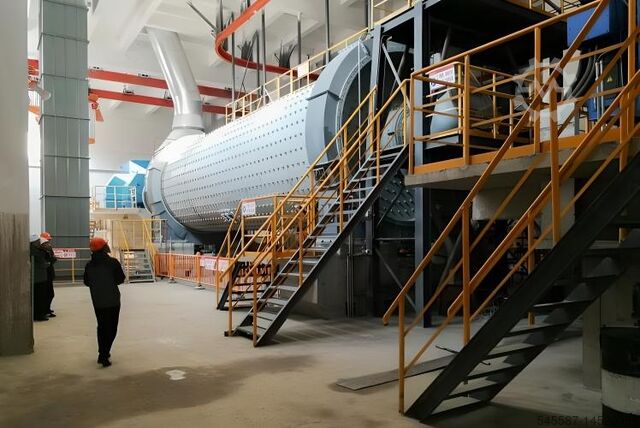
Ball mill for powder and mining plant
Mingyuan Ball Mill For Fine PowderPowder grinding mill for coal, silica
Call
Condition: new, functionality: fully functional, power: 55 kW (74.78 HP), Year of construction: 2026, Ball Mill for Powder and Mining Plant: Structure, Function, and Technical Details
A ball mill is a key grinding machine widely used in mining, metallurgy, cement, chemical, and powder-making industries. It is designed to grind various ores and other materials into fine powder through impact and attrition between steel balls and the material inside a rotating cylindrical shell. In mining plants, ball mills are essential for ore beneficiation, preparing materials for flotation, magnetic separation, or leaching processes. In powder production, they ensure uniform particle size and high surface area for further processing.
Working Principle
The ball mill operates on a simple yet effective principle: as the cylindrical shell rotates around its horizontal axis, the grinding media (steel or ceramic balls) are lifted along the inner wall by centrifugal force and friction. When they reach a certain height, they fall freely, striking and grinding the material below. This repeated motion causes both impact and abrasion, reducing the material to the desired fineness. The grinding process can be performed in dry or wet conditions depending on the application.
Structural Composition
A standard ball mill consists of several main components:
Feeding part: Equipped with a feeder or screw conveyor to ensure uniform material input.
Discharging part: Can be grate type or overflow type, depending on the discharge method.
Rotating part: The cylindrical shell made of steel plates, lined with wear-resistant liners.
Transmission system: Includes motor, reducer, small transmission gear, and electrical control.
Grinding media: Steel balls or ceramic balls of different diameters for efficient grinding.
The internal liner design and ball size distribution are optimized to achieve maximum grinding efficiency and minimal energy consumption.
Technical Details
Typical Specifications:
Feeding size: ≤25 mm
Discharge size: 0.074–0.4 mm
Capacity: 0.65–615 t/h (depending on model and material hardness)
Cylinder speed: 18–38 r/min
Power: 18.5–4500 kW
Liner material: High manganese steel, rubber, or alloy steel
Grinding media load: 30–45% of cylinder volume
Operating Modes:
Dry grinding: Suitable for materials that must remain moisture-free, such as cement clinker, limestone, and quartz.
Wet grinding: Common in ore beneficiation, where water or slurry improves grinding efficiency and particle uniformity.
Fpsdpfxeq Nf U Eo Afpji
Application in Mining Plants
In mining operations, ball mills are used after crushing to further reduce ore size and liberate valuable minerals. They are integrated into grinding circuits with classifiers, hydrocyclones, and flotation systems. The ground material is classified by size, and oversized particles are returned to the mill for regrinding. This closed-circuit system ensures consistent product fineness and efficient energy use.
Common Applications:
Gold, copper, iron, and zinc ore grinding
Cement clinker and slag processing
Silicate and ceramic powder production
Coal and mineral powder preparation
Conclusion
A ball mill is an indispensable piece of equipment in both powder production and mining beneficiation plants. Its ability to grind materials into fine, uniform particles makes it vital for downstream processes such as flotation, sintering, and chemical reactions.
Listing
Zheng Zhou Shi
3,684 km
Crushing equipment
Mingyuan Dry and Wet Ball MillCustomerizable Model for ball mill plant
Call
Condition: new, functionality: fully functional, Year of construction: 2026, Dry and Wet Ball Mill: Structure, Operation, and Technical Details
A ball mill is a fundamental grinding device used in mineral processing, cement manufacturing, chemical production, and other industrial applications. It works by rotating a cylindrical shell filled with grinding media—usually steel balls—causing impact and friction that reduce materials to fine powder. Based on the grinding environment, ball mills are classified into dry and wet types, each suited for specific materials and process requirements.
Working Principle
Both dry and wet ball mills operate on the same mechanical principle. The rotating cylinder, driven by a motor through a gear system, lifts the grinding media and material along the inner wall. As the rotation continues, the balls fall under gravity, striking and grinding the material. The difference lies in the presence or absence of a liquid medium during grinding.
Dry Ball Mill
A dry ball mill is used when the material must remain moisture-free or when water could affect product quality. It is commonly applied in cement clinker, limestone, quartz, and refractory material grinding. The discharge can be either grate type or overflow type, depending on the desired fineness.
Technical Features:
Feeding size: ≤25 mm
Discharge size: 0.075–0.4 mm
Capacity: 0.65–90 t/h
Liner material: High manganese steel or wear-resistant alloy
Drive system: Gear-driven or direct-coupled motor
Dust control: Equipped with air exhaust and dust collector
Advantages:
Suitable for materials sensitive to moisture
No drying process required after grinding
Lower corrosion risk and simpler maintenance
Easier material classification and separation
Limitations:
Dry grinding produces more dust and heat, requiring efficient ventilation and dust collection systems.
Wet Ball Mill
A wet ball mill operates with water or another liquid medium added to the material. The slurry formed during grinding improves efficiency by reducing friction and preventing excessive heat buildup. It is widely used in ore beneficiation, ceramics, and chemical industries.
Technical Features:
Feeding size: ≤25 mm
Discharge size: 0.074–0.2 mm
Capacity: 0.65–615 t/h
Liner material: Rubber or high-chromium steel
Discharge method: Overflow or grate type
Auxiliary equipment: Classifier, pump, and thickener for slurry circulation
Advantages:
Higher grinding efficiency and finer particle size
Reduced dust and noise levels
Continuous operation suitable for beneficiation circuits
Better control of particle uniformity
Limitations:
Requires drying if the final product must be in powder form and involves more complex slurry handling.
The selection between dry and wet grinding depends on the material characteristics, downstream process, and environmental conditions. Dry mills are preferred for materials that must stay moisture-free, while wet mills are ideal for fine grinding and slurry-based processes.
Conclusion
Fjdpoq Nx Alofx Afpepi
Dry and wet ball mills share the same mechanical structure but differ in their grinding environment and application scope. The dry type offers simplicity and low maintenance for moisture-sensitive materials, while the wet type provides higher efficiency and finer output for mineral and chemical processing. Understanding their technical parameters and operational differences ensures optimal equipment selection, improved productivity, and reliable performance in industrial grinding operations.
Listing
Zheng Zhou Shi
3,684 km
Cement mill,clinker grinding plant
Clinker grinding mill / cement ball millcement grinding with air classifier
Call
Year of construction: 2026, condition: new, functionality: fully functional, A cement clinker grinding mill is a specialized equipment used to grind the hard nodular clinker into fine powder, which is cement. Most cement is currently ground in ball mills and also vertical roller mills, which are more effective than ball mills.
Fpedpfeq Nfbhox Afpsi
Here are key features and information about cement clinker grinding mills:
1. Raw Materials:
- The main raw material for making cement is clinker, which is produced by sintering limestone and clay. Other materials such as gypsum, fly ash, or slag may also be added during the grinding process to achieve specific properties.
2. Grinding Process:
- The clinker and other additives are finely ground in the grinding mill to produce cement. The grinding process is a crucial step in cement production and contributes significantly to the final quality of the product.
3. Types of Mills:
- Ball Mills: Traditional ball mills are commonly used for grinding clinker. They operate by rotating a cylinder with steel grinding balls, causing the balls to fall back into the cylinder and onto the material to be ground.
- Vertical Roller Mills (VRM): VRM technology has become increasingly popular for clinker grinding. These mills use a rotating table with rollers to crush and grind the clinker, providing energy efficiency and a smaller footprint compared to ball mills.
4. Gypsum Addition:
- Gypsum is often added during the grinding process to control the setting time of the cement. It prevents flash setting of the clinker and facilitates the formation of a workable and pumpable cement paste.
5. Quality Control:
- Quality control measures, such as monitoring the fineness of the cement, chemical composition, and other properties, are implemented during the grinding process to ensure the final product meets the required specifications and standards.
6. Clinker Cooling:
- Before grinding, the clinker is produced by heating the raw materials in a kiln. The clinker is then cooled before entering the grinding mill to prevent excessive heat build-up during grinding.
7. Dust Collection and Environmental Considerations:
- Dust collectors and air pollution control systems are often employed to capture and control the dust generated during the grinding process, addressing environmental and safety concerns.
8. Packaging and Storage:
- After grinding, the cement is typically stored in silos before being packaged in bags or dispatched in bulk for distribution to construction sites or for sale in the market.
Cement clinker grinding mills play a crucial role in the cement production process, and advancements in technology continue to improve the efficiency and environmental sustainability of the grinding process.
Technical details
We have different options for different requirements, please contact our team for more info.
Listing
Zheng Zhou Shi
3,684 km
Powder grinding mill
ball mill for mining &fine powder makingsilica/Barite/limestone powder plant
Call
Condition: new, Year of construction: 2026, power: 300 kW (407.89 HP), Ball Mill for Mining & Fine Powder Making:
A ball mill is a fundamental grinding device widely used in mining, metallurgy, cement, and chemical industries. It is designed to grind ores and other materials into fine powder through impact and attrition between steel balls and the material inside a rotating cylindrical shell. In mining plants, ball mills are essential for ore beneficiation, while in powder-making industries, they ensure uniform particle size and high surface area for further processing.
Working Principle
The ball mill operates on the principle of impact and friction. As the cylindrical shell rotates around its horizontal axis, the grinding media—usually steel or ceramic balls—are lifted along the inner wall by centrifugal force and friction. When they reach a certain height, they fall freely, striking and grinding the material below. This repeated motion breaks down the material into fine particles. The process can be carried out in dry or wet conditions depending on the application.
Structural Composition
A standard ball mill consists of several main components:
Feeding part: Ensures uniform material input through a feeder or screw conveyor.
Discharging part: Can be grate type or overflow type, depending on the discharge method.
Rotating part: The cylindrical shell made of steel plates, lined with wear-resistant liners.
Transmission system: Includes motor, reducer, small transmission gear, and electrical control.
Fsdpfx Afoq Ngafjpopi
Grinding media: Steel or ceramic balls of various diameters for efficient grinding.
The internal liner design and ball size distribution are optimized to achieve maximum grinding efficiency and minimal energy consumption.
Technical Details/Typical Specifications:
Feeding size: ≤25 mm
Discharge size: 0.074–0.4 mm
Capacity: 0.65–615 t/h (depending on model and material hardness)
Cylinder speed: 18–38 r/min
Power: 18.5–4500 kW
Liner material: High manganese steel, rubber, or alloy steel
Grinding media load: 30–45% of cylinder volume
Operating Modes:
Dry grinding: Used for materials that must remain moisture-free, such as cement clinker, limestone, and quartz.
Wet grinding: Common in ore beneficiation, where water or slurry improves grinding efficiency and particle uniformity.
Application in Mining and Powder Production
In mining operations, ball mills are used after crushing to further reduce ore size and liberate valuable minerals. They are integrated into grinding circuits with classifiers, hydrocyclones, and flotation systems. The ground material is classified by size, and oversized particles are returned to the mill for regrinding. This closed-circuit system ensures consistent product fineness and efficient energy use.
In fine powder production, ball mills are used to produce materials such as silicate, ceramic powder, refractory materials, and chemical raw materials. The uniform particle size achieved by ball milling enhances product quality and performance in downstream applications.
Conclusion
A ball mill is an indispensable piece of equipment for both mining and fine powder making. Its ability to grind materials into fine, uniform particles makes it vital for ore beneficiation and industrial powder production. With flexible configurations, high efficiency, and reliable operation, modern ball mills provide a cost-effective and energy-efficient solution for large-scale grinding, ensuring consistent quality and productivity across diverse applications.
Listing
Zheng Zhou Shi
3,684 km
Roll forming line
Rod ball mill / Rod Grinding MillFor Sand and mining beneficiation plant
Call
Condition: new, Year of construction: 2026, We have various kinds of ball grinding mill such as batch ball mill, rod mill, cement ball mill, mining ball mill, welcome to contact our team for further details according to your specific requirements.
Fpedpeq I Nw Ijfx Afpei
Listing
Zheng Zhou Shi
3,684 km
Fine Powder Grinding Plant
Cement mill & Ultrafine Grinding MillFine Powder Grinding Plant
Call
Condition: new, functionality: fully functional, Year of construction: 2026, Cement Mill & Ultrafine Grinding Mill
🏗️ Introduction to Cement Mill & Ultrafine Grinding Mill
In the world of construction and materials processing, achieving the right particle size is essential. Introducing the Cement Mill and Ultrafine Grinding Mill—two pivotal machines designed to deliver superior grinding performance for cement production and ultrafine materials. Let’s dive into their features and applications! 💼
🔥 What is a Cement Mill?
A Cement Mill is a crucial piece of equipment in cement production. It grinds clinker, gypsum, and other additives to produce fine cement powder. This machine ensures the optimal particle size for high-quality cement, essential for building robust structures. 🚀
🔧 What is an Ultrafine Grinding Mill?
An Ultrafine Grinding Mill is designed to produce extremely fine powders from various raw materials, such as minerals, chemicals, and industrial waste. It operates at high efficiency, delivering ultra-fine materials for advanced applications like coatings, plastics, and ceramics. 🌟
💼 Key Benefits of Using Cement Mill & Ultrafine Grinding Mill
1. High Efficiency: Both mills are engineered for maximum efficiency, ensuring rapid processing times and reduced energy consumption. 🌿💡
2. Superior Grinding Performance: Achieve consistent, high-quality output with precise control over particle size. 🏭
3. Versatility: Suitable for a wide range of materials, making them essential for various industrial applications. 🌳
4. Durability and Reliability: Built with robust materials, these mills offer long-lasting performance in demanding industrial environments. 💪
📈 Applications in Industry
Cement Mill Applications:
1. Cement Production: Essential for producing high-quality cement for construction projects.
2. Infrastructure Development: Used in creating concrete for roads, bridges, and buildings.
Fodpfx Afeq Nyydepopi
Ultrafine Grinding Mill Applications:
1. Mineral Processing: Producing ultra-fine powders for advanced material applications.
2. Chemical Manufacturing: Used in creating fine chemicals for various industrial processes.
3. Environmental Applications: Grinding industrial waste for recycling and reuse. ♻️
🌟 Conclusion
Whether you’re in construction, materials processing, or advanced manufacturing, the Cement Mill and Ultrafine Grinding Mill are indispensable tools. Their efficiency, versatility, and superior performance make them a valuable addition to any production line. Contact us today to learn more about these innovative machines and how they can revolutionize your operations! 📞
Listing
Passau
6,530 km
Asphalt mixing plant
Probst VS 140/200
Call
Condition: new, Year of construction: 2015, Storage location number: 100636087
Transport dimensions (L x W x H): 0 x 0 x 0
Fsdpfx Ajzkz Rpjfpepi
Listing
Passau
6,530 km
Asphalt mixing plant
PramacS 8000 240V
Call
Condition: new, Year of construction: 2024, operating hours: 129 h, Storage location number: 100637990
Transport dimensions (L x W x H): 0 x 0 x 0
---- good condition
Fjdpszkzyqefx Afpopi
Listing
Wiefelstede
6,930 km
Clamping device from window manufacturing plant
Gubisch FimecDST H Hub 120 mm
Call
Condition: good (used), Year of construction: 1994, Window processing line, CNC window manufacturing plant, window angle machine, clamping device, pneumatic clamp
-Manufacturer: Gubisch, clamping device from window manufacturing plant type DST H
-Stroke: 120 mm
-Clamping cylinder: airtec HM-25-120
-Number: 2x clamping device available
-Price: per piece
Fpjdpfx Afoyibx Aopji
-Dimensions: 560/225/H80 mm
-Weight: 5 kg/pc.
Trust Seal
Dealers certified through Machineseeker

Listing
Wiefelstede
6,930 km
Screening plant control screening machine
SiebtechnikPerflux
Call
Condition: good (used), circular vibrating screening plant, screening machine, vibrating screen, vibrating screen, vibration motor, shaker, sorting system, shaking system, sifter, control screening machine, analysis screening machine
Fjdsvgw Rnepfx Afpspi
-Manufacturer: Siebtechnik, control sieving machine Elekto-Schnellsieb with 5 sieve inserts
-Type: Perflux for the production of grinding wheels
-Sieve inserts: Size 60 my to 2360 my, see photo parts list
-Transport dimensions: 1200/800/H670 mm / 1200/800/H800 mm
-Weight: 115 kg
Listing
Wiefelstede
6,930 km
Wastewater treatment plant
ENVIRO-CHEMIE500 M
Call
Condition: good (used), Wastewater treatment plant, drilling water purification, chip separator, paper filter, paper belt filter
-Tank dimensions: 1000/700/H800 mm
-Agitator: 0.75 kW
-Speed: 1500 rpm
Fjdpfx Ajb A Ngpjfpopi
-Equipment: as shown in pictures, conveyor belt filter/agitator
-Dimensions: 1100/710/H1650 mm
-Weight: 130 kg
Listing
Wiefelstede
6,930 km
Profiling plant replacement stations
Braun5 Stationen
Call
Condition: good (used), Folding machine, folding machine, form folding machine, profiling machine, profiling system, slat manufacturing, blind manufacturing
Fsdpfx Afjpvqy Dspspi
-Profiling plant: Replacement stations for ID26309
-Profiling machine: heavy-duty design, used for manufacturing slats/blinds
-bottom profiling stations: 5 pieces
-Drive shaft: Ø 35mm
-Dimensions: 4x 700/390/H400 mm 2x 300/200/H160 mm
-Weight: 702 kg
Listing
Wiefelstede
6,930 km
Thermal exhaust air combustion plant
LTG20000 Nm³/h
Call
Condition: good (used), Year of construction: 1999, thermal exhaust air combustion system, exhaust gas filter system, exhaust gas filter system, exhaust gas filter, hot filter, industrial exhaust gas filter
-Thermal exhaust air combustion plant: Manufacturer LTG Type 20000 Nm³/h
-Protocols: regarding maintenance and emissions are available
Documentation: complete
-Combustion chamber temperature: 850° C
-Heating fuel: Natural gas
-Calorific value: 10 kWh/m³
-Connected load: 45 kW
-Exhaust air volume: 20,000 Nm³/h
-Max. solvent quantity: 1.5 g/m³
Fodpfxjvtzdlj Afpepi
-Individual components: see photos
We make it easier for you to find: "asepto uht plant"
You will receive new offers immediately and free of charge via e-mail
You can easily terminate the search request at any time
This may be of interest to you

Get information now
+44 20 806 810 84
+44 20 806 810 84
List now
*per listing / month