Used Italforni Ec9-I for sale (53,729)
Sort results
- Lowest price Highest price
- Newest listings Oldest listings
- Shortest distance Farthest distance
- Newest year of manufacture Oldest year of manufacture
- Latest update Oldest update
- Manufacturer A to Z Manufacturer Z to A
- Relevance
- Lowest price
- Price
- Highest price
- Price
- Newest listings
- Release date
- Oldest listings
- Release date
- Shortest distance
- Distance
- Farthest distance
- Distance
- Newest year of manufacture
- Year of construction
- Oldest year of manufacture
- Year of construction
- Latest update
- Update
- Oldest update
- Update
- Manufacturer A to Z
- Manufacturer
- Manufacturer Z to A
- Manufacturer
- designation from A to Z
- Description
- designation from Z to A
- Description
- Model from A to Z
- Model
- Model from Z to A
- Model
- Lowest reference
- Ref.No.
- Highest reference
- Ref.No.
- Shortest runtime
- Runtime
- Longest duration
- Runtime
- Relevance
- Relevance
Listing
Krefeld
7,031 km
Centrifugal pump
HILGEEURO-Hygia-I-Bloc
Call
Year of construction: 2018, condition: good (used), coolant capacity 10 m3l/h
Headroom 20 m
operating pressure 2 bar
voltage 230/400 V - 50 Hz
motor speed 2900 U/min
motor type 90 L
engine output 2,2 kW
weight 35 kg
Standard suction centrifugal pump,
Fpjdpfx Aeub Utdoatol
Stainless steel housing and impeller,
Flange connections,
Serial No.: 22/04-140200
Listing
Weiterstadt
6,885 km
Machining center
HurcoVMX 24 i
Call
Condition: good (used), Year of construction: 2006, Hurco machining center VMX 24 i IKZ chip worm spindle mount Sk 40
Fpsdpfxsudb I Tj Aatsl
Listing
Düsseldorf
7,013 km
High Lift stacker
LindeL12 I // UVV // Baugleiche Geräte verfügbar
Call
Condition: used, functionality: fully functional, machine/vehicle number: F21172J03881, Year of construction: 2018, operating hours: 3,067 h, load capacity: 1,200 kg, lifting height: 2,110 mm, fuel type: electric, mast type: simplex, construction height: 1,500 mm, fork length: 1,150 mm, drive type: Elektro, High lift truck
Fahrgestellnummer: F21172J03881
Mast type: Standard
Condition: Ready for use and fully functional
Technical condition: Very good
Battery Volt: 24V
Fedpfx Aouhw Eceatjpl
Description: Linde L12 I R0080 Year of construction: 2018 Operating hours: 3067 The device is visually and technically in very good condition. Charger on request. In our stock there are two more devices with this model type and standard mast. The fork length is 1150mm for all of them, while the overall height is 1500mm or 1690mm and the lifting height is 2110mm or 2424mm. The operating hours range from 1338h to 3166h. Fast and uncomplicated transportation possible by arrangement! The advertisement only serves to identify the machine! A detailed description of the condition and possible equipment will be provided individually on request! Subject to errors and prior sale, sale only to tradespeople. Any sale of used goods is subject to the exclusion of warranty or guarantee. If you have not found the forklift you are looking for, please contact us. We have a large selection of other equipment on site.
Initial lift,
Listing
Wiefelstede
6,930 km
DC gear motor 24 Volt 340 rpm
KähligM63x22/I+SN31+IGMi12/2
Call
Condition: good (used), DC motor, servo motor, gear motor, electric motor, DC gear motor, DC shunt gear motor
Fpodpfx Aajtr R A Ejtel
-Manufacturer: Kählig, DC gear motor
-Type: M63x22/I SN31 IGMi12/2
-Voltage: 24 V
-Torque: 108 N/cm
-Speed: 340 rpm
-technical data: see photo type plate
-Shaft: Ø 10 x 28 mm
-Number: 4x engines available
-Price: per piece
-Dimensions: 170/100/H100 mm
-Weight: 2.0 kg/piece
Listing
Wiefelstede
6,930 km
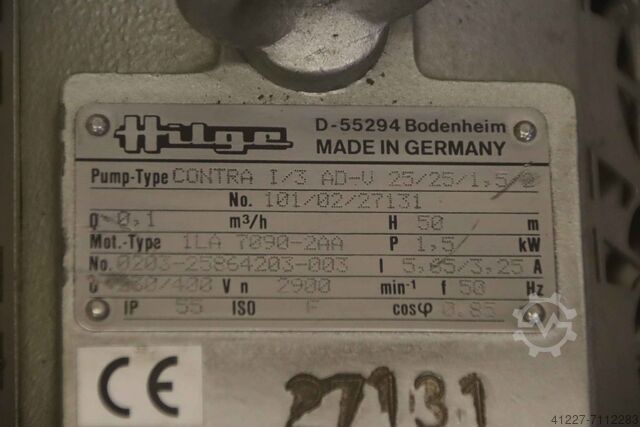
Centrifugal pump 1.5 kW
HilgeContra I/3 AD-V 25/25/1,5/2
Call
Condition: used, centrifugal pump, water pump, stainless steel pump, food pump
Fpsdpfxoh Hbw Nj Aatel
-Manufacturer: Hilge, stainless steel centrifugal pump
-Type: Contra I/3 AD-V 25/25/1.5/2
-Motor: Siemens 1.50 kW / 2860 rpm
-Inlet/outlet pipe connection DN25
-Dimensions: 715/215/H265 mm
-Weight: 37 kg
Listing
Roreto
6,952 km
EDGEBANDER FOR BATCH-SIZE ONE (LASER)
IMANovimat LASER System/I/R75/1110/R3
Call
Condition: excellent (used), SINGLE-SIDE EDGE BANDER (LEFT-side)
Edges (band in rolls) thickness (Min/Max) mm 0,3 / 3 - in stips / lippings mm max 1
Panels thickness (min/max) mm 14 / 60 (LASER - Max 50)
Numerical Control ICOS Open
Feeding speed (adjustable) m/min 6 - 30
Top pressure system with rubber belt
Fpedji Hn Sropfx Aatjl
Spraying unit (Anti-sticking liquid)
In-feed fence, adjustable by N.C.
Panels in-feed (servo) system A1 / 15
Pre-milling Unit (vertical joint trimmers) 08.378 (2 x Kw 4,5) adjustable by N.C.
Glueing Unit (P.U.R. Glue + Quick Melt unit) 283.201 + 283.203
Glueing Unit (Thermofusion with Laser) Laser System LASERLINE
Spraying Unit (for anti-release liquid)
Band Pressure zone + Edge coils supporting unit (No. 36 + 12 reels)
Snipping (end-cutting) 08.42 (Kw 0,2 x 2) work speed up to 30 m/min (0°-25°)
Rough Trimming unit 08.0555 HS/LS1 (Kw 1 x 2)
Fine Trimming unit (Multi-profile, by N.C. adjustment, for 4 profiles) 08.0587 (Kw 0,66 x 1)
Multi-Profile Copying unit by N.C (fine + contour trimming) KFA 30 (Kw 0,5 x 1) max 30 m/min
Profile Scraping unit (Multi-profile, by N.C. adjustment, for 4 profiles) 08.0516
Glue scraping unit 08.521
Spraying Unit (for polishing liquid)
Buffing unit 08.614 (Kw 0.25 x 4)
No. 2 Milling grooving units 08.190 (Kw 4,5 x 2) swivelling 90°/180°/270° (adjustable by CN)
Listing
Wiefelstede
6,929 km
Sheet metal clamp 0-40 mm
ip6 I P 6000 kg
Call
Condition: used, Beam claw, sheet metal clamp, sheet metal claw, beam clamp, sheet metal gripper, material gripper, material gripper, profile steel gripper, panel gripper, lifting claw, lifting clamp
-Manufacturer: ip, safety lifting claw 6 IP
-Clamping range: 0 - 40 mm
-Load capacity: 6 t
-Dimensions: 250/110 / H550 mm
Fjdpfxsgtn Dfe Aatspl
-Weight: 26 kg
Listing
Zheng Zhou Shi
3,684 km
Construction debris/waste recycling line
jaw cone crusher plant 30-300 tphConstruction & Demolition Recycling Line
Call
Condition: new, Year of construction: 2026, functionality: fully functional, power: 75 kW (101.97 HP), Jaw crusher for stone & ore crushing in quarry and mining fields
Model: PE600X900
Max input size: 500mm
Capacity: 80-135 t/h
Motor: 75KW
Weight: 15T
Besides this models, we also have the other models like PE900X1200, PE500X750, PE250X400, PE400X600, etc, and we also have impact crusher, cone crusher, hammer crusher, vsi crusher, more important we can also provide complete stone crushing screening plant with capacity 30-1000 t/h, welcome to contact us for more details if you want a different model or the other type of crushing machine.
You can leave us a message if you need a different model or a different type of crusher.
Fpedpsq H Shcsfx Aatsl
Listing
Zheng Zhou Shi
3,684 km
Construction/Building debris Recycling
Construction & Demolition RecyclingConstruction Waste Recycling Equipment
Call
Condition: new, functionality: fully functional, power: 260 kW (353.50 HP), fuel type: electric, color: dark red, overall weight: 42,000 kg, operation weight: 42,000 kg, chain condition: 100 %, axle configuration: 3 axles, Year of construction: 2026, The construction industry is moving away from the "build-demolish-dump" cycle and toward Urban Mining. At the heart of this shift is the Mobile Stone Crusher, a powerhouse designed to turn piles of jagged concrete and brick into high-quality recycled aggregate right on the job site.
---
## 1. The Engineering Logic: From Waste to Wealth
In a traditional setup, demolition waste is hauled to a landfill—a process that is expensive, carbon-heavy, and wasteful. A mobile crusher flips the script. It brings the factory to the waste. By processing materials on-site, contractors save on transport costs and produce "Road Base" or "Sub-base" materials immediately.
### Key Components of a Mobile C&D Plant:
* Vibrating Feeder: Uses a "Grizzly" bar system to pre-screen fines (dirt/sand) so the crusher only works on the big stuff.
* Crushing Unit: Usually a Jaw Crusher (for primary compression) or an Impact Crusher (for better grain shape and higher reduction ratios).
* Magnetic Separator: This is the "secret sauce" for C&D waste. It pulls out rebar and scrap metal that would otherwise contaminate the recycled aggregate.
* Discharge Conveyor: Transports the finished product to a stockpile.
---
## 2. Technical Specifications & Performance
When evaluating these machines, "Throughput" ($TPH$ or Tons Per Hour) is the metric that matters. For C&D recycling, the machine must handle unpredictable feed sizes and varied material hardness.
### Typical Technical Specifications Table
| Feature | Specification Range | Why it matters |
| --- | --- | --- |
| Throughput | 100 – 500 $t/h$ | Determines project timeline efficiency. |
| Max Feed Size | 500mm – 1,100mm | Dictates if you need a hydraulic breaker first. |
| Power Source | Diesel-Electric or Hydraulic | Dual power (Electric) is better for urban noise/emissions. |
| Crusher Type | Jaw or Impact | Impactors provide a more "cubic" final product. |
| Mobility | Crawler Tracks | Essential for moving over uneven rubble piles. |
---
## 3. The "C&D" Specialization
Recycling construction waste isn't just about "breaking rocks." It’s about cleaning material. Modern mobile units are equipped with:
1. Over-belt Magnets: Specifically designed to lift heavy steel reinforcement bars (rebar) out of the crushed concrete flow.
2. Dust Suppression: High-pressure misting systems to keep neighbors happy and workers healthy in tight urban environments.
3. Active Pre-screening: Removing sticky soil or asphalt fines before they enter the crushing chamber to prevent "plugging."
> The Insight: Using a mobile crusher can reduce project carbon footprints by up to 40% simply by eliminating the "truck-in, truck-out" logistics of aggregate management.
---
## 4. Maintenance and Longevity
Because C&D waste is highly abrasive (and often contains "surprises" like wood or plastic), maintenance is non-negotiable.
Fsdpsq I Nviefx Aatepl
* Jaw Plates: Must be flipped or replaced regularly to maintain the "Closed Side Setting" (CSS), which determines the size of your output.
* Blow Bars: In impact crushers, these are the high-wear items that take the brunt of the force.
---
Would you like me to compare the cost-effectiveness of Jaw vs. Impact crushers for a specific type of demolition project, or perhaps look into the environmental regulations regarding on-site crushing?
Listing
Zheng Zhou Shi
3,684 km
Glass grinding machine
Henan Mingyuan Ceramic /Silica Ball MillBatch ball mill for glass ceramic making
Call
Condition: new, Year of construction: 2026, power: 7.5 kW (10.20 HP), Batch ball mills find applications in various industries where the processing of materials in discrete batches is required. The versatility of batch ball mills makes them suitable for a range of applications. Here are some common batch ball mill applications:
1. Ceramics Industry:
- *Glaze Preparation:* Batch ball mills are extensively used in the ceramics industry for preparing glazes. Raw materials such as feldspar, quartz, and clay are ground with ceramic balls to achieve the desired particle size for glaze formulation.
2. Chemical Industry:
- *Material Grinding:* Batch ball mills are used for grinding and blending various chemical materials. This includes the production of pigments, dyes, and other specialty chemicals where precise particle size control is crucial.
3. Pharmaceuticals:
- *Drug Formulation:* In pharmaceutical manufacturing, batch ball mills are used for grinding and blending powders to create drug formulations. The controlled environment provided by these mills is essential for maintaining the integrity of pharmaceutical compounds.
Fpjdpoq I N H Njfx Aatol
4. Food Industry:
- *Ingredient Mixing:* Batch ball mills may find application in the food industry for mixing and grinding ingredients. This can include the production of food additives, flavorings, and other powdered or granular products.
5. Mining and Minerals Processing:
- *Ore Grinding:* Batch ball mills are used in mining and minerals processing for grinding minerals and ores. The controlled grinding helps in obtaining the desired particle size for subsequent processes, such as mineral separation or extraction.
6. Paints and Coatings:
- *Pigment Dispersion:* In the paints and coatings industry, batch ball mills are employed for dispersing pigments into paint formulations. Achieving a uniform particle size is crucial for the quality and appearance of the final coating.
7. Building Materials:
- *Raw Material Grinding:* Batch ball mills are used in the preparation of raw materials for the production of building materials, such as cement and concrete. Grinding of materials like limestone and clay helps in obtaining the desired fineness for subsequent processes.
8. Electronic Materials:
- *Ceramic Powder Processing:* In the electronics industry, batch ball mills can be employed for processing ceramic powders used in the production of electronic components and insulating materials.
9. Research and Development:
- *Material Testing:* Batch ball mills are often used in research and development laboratories for testing and optimizing material formulations. They provide a controlled environment for small-scale processing and experimentation.
10. Customized Applications:
- *Specialized Processes:* Batch ball mills can be adapted for various specialized processes in different industries where precise grinding and mixing are required. Custom modifications can be made based on specific application requirements.
When using a batch ball mill, it's important to consider factors such as the type of material being processed, desired particle size, and the specific requirements of the end product. Additionally, following the manufacturer's guidelines and maintaining proper operating conditions are essential for efficient and effective milling processes.
Technical details
We have different options for different requirements, please contact our team for more info.
Listing
Zheng Zhou Shi
3,684 km
Drying system
Single & Triple pass rotary dryerFor wood, sawdust,coal,fertilizer drying
Call
Condition: new, Year of construction: 2026, functionality: fully functional, power: 11 kW (14.96 HP), A triple pass rotary drum dryer is a type of industrial dryer that is used to reduce or remove moisture from a material. It gets its name from the three rotating drums through which the material passes, each with a different purpose in the drying process. This type of dryer is commonly used in the production of various bulk solids, including minerals, agricultural products, and biomass.
Here are the key features and components of a triple pass rotary drum dryer:
1. Triple Pass Design:
- The material being dried passes through three rotating drums or cylinders, hence the term "triple pass." Each drum serves a specific purpose in the drying process.
2. Material Flow:
- The material enters the dryer and first passes through the innermost drum. After the initial drying phase, it moves to the middle drum and then to the outer drum, undergoing additional drying in each pass.
3. Heat Source:
- Heat is typically provided by a combustion system, such as a burner or furnace, located at one end of the drum dryer. The hot gases generated by the combustion process flow through the rotating drums, transferring heat to the material.
4. Air Flow:
- The dryer is designed to optimize air flow through the drums, ensuring efficient drying. In a triple pass design, the material and hot gases move counter-currently through the three drums, enhancing heat transfer and drying efficiency.
5. Lifting Flights or Lifters:
- Lifters are internal components inside the drums designed to lift and cascade the material as it rotates. This movement promotes good heat transfer and uniform drying.
6. Retention Time:
Fedpjq Nfuzjfx Aatepl
- The triple pass configuration allows for an extended retention time of the material in the drying system. This longer exposure to heat enhances the drying efficiency, making the triple pass rotary drum dryer suitable for materials with high moisture content.
7. Cooling Section:
- After the material completes the three passes and reaches the end of the drum dryer, a cooling section may be included to reduce the temperature of the dried material before it is discharged.
8. Applications:
- Triple pass rotary drum dryers are used in various industries, including agriculture (drying crops like grains), minerals (drying ores or concentrates), and biomass (drying wood chips or other organic materials).
9. Efficiency and Energy Consumption:
- Triple pass rotary drum dryers are known for their high efficiency due to the extended drying time and effective heat transfer. However, they may have higher energy consumption compared to single or double pass dryers.
When selecting a triple pass rotary drum dryer, it's essential to consider factors such as the type of material to be dried, required moisture reduction, and overall processing requirements. Proper design and operation are crucial to achieving optimal drying performance.
Technical details
We have different options for different requirements, please contact our team for more info.
Listing
Zheng Zhou Shi
3,684 km
Powder grinding machine
Fine powder grinding mill, clinker millSuperfine ball mill for micro powder
Call
Condition: new, Year of construction: 2026, A superfine ball mill is a type of milling machine that is used to grind materials into very fine particles. This type of ball mill has some distinctive features that make it especially suitable for processing even the hardest materials with low contamination and minimal wear. It is commonly used in various industries, including pharmaceuticals, minerals, pigments, and chemicals, for producing micro powder or nanoparticles.
Here are some key features and considerations for a superfine ball mill for micro powder:
1. High Grinding Efficiency: Superfine ball mills are designed to achieve high grinding efficiency by utilizing grinding media with a relatively small size, leading to a large surface area for grinding.
Fpjdpfx Ajq Nf Uwjatel
2. Precision Control: These mills often come with advanced control systems to regulate parameters like rotation speed, temperature, and grinding time, allowing precise control over the particle size distribution.
3. Specialized Design: The mill is typically designed with features to minimize contamination, such as using materials resistant to wear and corrosion. Some mills also have cooling systems to prevent overheating during the milling process.
4. Variety of Materials: Superfine ball mills can handle a wide range of materials, including both brittle and fibrous substances. They are often used for milling hard materials that require fine grinding, such as ceramics, minerals, or pigments.
5. Size Reduction to Micro or Nano Level: The primary goal of a superfine ball mill is to reduce particle size to the micro or even nano level. This is achieved by the intense grinding action that occurs within the mill.
6. Classifier System: Some superfine ball mills incorporate a classifier system to control the particle size distribution more precisely. This allows for the separation of fine particles from coarser ones during the milling process.
7. Batch or Continuous Operation: Depending on the specific design, these mills can operate in either batch or continuous mode, offering flexibility based on the production requirements.
8. Safety Measures: Safety features may be included, such as monitoring and control systems to prevent overloading, overheating, or other potential issues during operation.
When selecting a superfine ball mill for micro powder production, it's important to consider the specific requirements of your application, the characteristics of the materials you're working with, and the desired final particle size distribution. Always follow the manufacturer's guidelines for operation, maintenance, and safety to ensure optimal performance and longevity of the equipment.
Listing
Zheng Zhou Shi
3,684 km
Powder grinding mill
ball mill for mining &fine powder makingsilica/Barite/limestone powder plant
Call
Condition: new, Year of construction: 2026, power: 300 kW (407.89 HP), Ball Mill for Mining & Fine Powder Making:
A ball mill is a fundamental grinding device widely used in mining, metallurgy, cement, and chemical industries. It is designed to grind ores and other materials into fine powder through impact and attrition between steel balls and the material inside a rotating cylindrical shell. In mining plants, ball mills are essential for ore beneficiation, while in powder-making industries, they ensure uniform particle size and high surface area for further processing.
Working Principle
The ball mill operates on the principle of impact and friction. As the cylindrical shell rotates around its horizontal axis, the grinding media—usually steel or ceramic balls—are lifted along the inner wall by centrifugal force and friction. When they reach a certain height, they fall freely, striking and grinding the material below. This repeated motion breaks down the material into fine particles. The process can be carried out in dry or wet conditions depending on the application.
Structural Composition
A standard ball mill consists of several main components:
Feeding part: Ensures uniform material input through a feeder or screw conveyor.
Discharging part: Can be grate type or overflow type, depending on the discharge method.
Rotating part: The cylindrical shell made of steel plates, lined with wear-resistant liners.
Fjdpfoq Ngafsx Aatepl
Transmission system: Includes motor, reducer, small transmission gear, and electrical control.
Grinding media: Steel or ceramic balls of various diameters for efficient grinding.
The internal liner design and ball size distribution are optimized to achieve maximum grinding efficiency and minimal energy consumption.
Technical Details/Typical Specifications:
Feeding size: ≤25 mm
Discharge size: 0.074–0.4 mm
Capacity: 0.65–615 t/h (depending on model and material hardness)
Cylinder speed: 18–38 r/min
Power: 18.5–4500 kW
Liner material: High manganese steel, rubber, or alloy steel
Grinding media load: 30–45% of cylinder volume
Operating Modes:
Dry grinding: Used for materials that must remain moisture-free, such as cement clinker, limestone, and quartz.
Wet grinding: Common in ore beneficiation, where water or slurry improves grinding efficiency and particle uniformity.
Application in Mining and Powder Production
In mining operations, ball mills are used after crushing to further reduce ore size and liberate valuable minerals. They are integrated into grinding circuits with classifiers, hydrocyclones, and flotation systems. The ground material is classified by size, and oversized particles are returned to the mill for regrinding. This closed-circuit system ensures consistent product fineness and efficient energy use.
In fine powder production, ball mills are used to produce materials such as silicate, ceramic powder, refractory materials, and chemical raw materials. The uniform particle size achieved by ball milling enhances product quality and performance in downstream applications.
Conclusion
A ball mill is an indispensable piece of equipment for both mining and fine powder making. Its ability to grind materials into fine, uniform particles makes it vital for ore beneficiation and industrial powder production. With flexible configurations, high efficiency, and reliable operation, modern ball mills provide a cost-effective and energy-efficient solution for large-scale grinding, ensuring consistent quality and productivity across diverse applications.
Listing
Zheng Zhou Shi
3,684 km
Crushing equipment
Smooth & teeth double roller crusherRoller crusher for sand, coal crushing
Call
Condition: new, functionality: fully functional, Year of construction: 2025, A double teeth roller crusher is a type of roller crusher commonly used in industries that involve the crushing of various materials, such as mining, metallurgy, building materials, and chemical processing. This crusher is characterized by its two pairs of closely spaced, parallel, and oppositely rotating rolls with "teeth" or "knurling" on their surfaces. The teeth are designed to grab and crush the material, providing efficient and uniform size reduction.
Here are key features and aspects of double teeth roller crusher equipment:
1. Double Roller Design:
- The crusher features two parallel, counter-rotating rollers, each with a set of teeth or knurling on its surface. The dual roller design facilitates a consistent and efficient crushing process.
2. Teeth Configuration:
- The teeth on the rollers are designed to grip and crush the material. The arrangement and shape of the teeth may vary based on the specific application and the characteristics of the material being processed.
3. Adjustable Gap Settings:
- The gap between the rollers can usually be adjusted to control the size of the crushed particles. This feature allows for customization of the final product size.
4. Material Feed and Discharge:
- Material is typically fed into the top of the crusher and is crushed between the rotating rollers. The crushed material is discharged at the bottom of the machine.
5. High Efficiency:
- Double teeth roller crushers are known for their high efficiency in crushing various materials. The dual roller design provides a more consistent and controlled process compared to single roller crushers.
6. Versatility:
- These crushers are versatile and can be used for various materials, including coal, limestone, slag, clay, and other similar materials.
7. Application in Mining and Processing:
- Double teeth roller crushers are commonly used in the mining industry for the crushing of minerals and ores. They are also utilized in other industries for size reduction and processing of materials.
8. Dust and Noise Control:
- Some double teeth roller crushers are equipped with features to control dust emissions and reduce noise during operation, improving the working environment.
9. High Torque and Power:
- A powerful motor and a robust drive system are essential components to drive the rotation of the rollers, providing the necessary torque and power for efficient crushing.
10. Maintenance and Safety:
- Regular maintenance is essential for optimal performance. Safety features, such as emergency stops and safety guards, are often incorporated to ensure safe operation.
11. Application in Size Reduction:
- Double teeth roller crushers are effective in size reduction and are suitable for applications where precise control over the final product size is crucial.
Fedpfx Ajq Nga Ueatopl
It's important to note that the specific design, features, and applications of double teeth roller crushers can vary among different models and manufacturers. When selecting or using this type of equipment, it's advisable to refer to the manufacturer's guidelines and specifications for proper operation and maintenance.
Listing
Zheng Zhou Shi
3,684 km
Crushing equipment
Mobile / Stationary stone crusher plantSand & aggregate production plant
Call
Condition: new, Year of construction: 2025, A sand aggregate production plant is a facility where various types of aggregates (such as sand, gravel, crushed stone, or recycled concrete) are produced for use in construction and other applications. These plants typically include various stages of processing, from raw material extraction to the final product.
Fpsdpeq Ngb Defx Aatjl
Here are the key components and processes typically involved in a sand aggregate production plant:
1. Raw Material Extraction:
- Quarrying or Mining: Aggregates are often extracted from quarries, mines, or riverbeds. Depending on the type of aggregate, the extraction process may involve drilling, blasting, or dredging.
2. Primary Crushing:
- Jaw Crusher or Gyratory Crusher: The extracted raw material is usually transported to the plant and fed into a primary crusher, where large rocks are broken down into smaller pieces.
3. Secondary Crushing:
- Cone Crusher or Impact Crusher: The crushed material from the primary crusher may undergo further reduction in size through secondary crushing.
4. Screening:
- Vibrating Screens: After crushing, the material is often screened to separate different sizes of aggregates. This process ensures that the final product meets the required specifications.
5. Washing:
- Sand Washers: In some cases, especially for sand production, washing is done to remove impurities, clay, and fines from the aggregates, ensuring a cleaner and higher-quality product.
6. Grading and Sorting:
- Classifiers or Graders: After washing and screening, the aggregates may go through additional processes to separate them based on size or quality.
7. Stockpiling:
- Stockpiles: The final aggregates are usually stockpiled for storage before being transported to construction sites or other end-users.
8. Aggregate Storage and Handling:
- Storage Bins or Silos: Larger production plants may have storage facilities, such as bins or silos, to store different types and sizes of aggregates before distribution.
9. Quality Control:
- Laboratory Testing: Regular quality control testing is performed on aggregates to ensure they meet specifications for strength, size, gradation, and other properties.
10. Environmental Considerations:
- Water Management: Some plants incorporate water management systems to recycle and reuse water used in the washing process, minimizing environmental impact.
11. Transportation:
- Conveyors or Trucks: Aggregates are typically transported from the production plant to construction sites by conveyors, trucks, or other means.
Listing
Zheng Zhou Shi
3,684 km
Bauxite Granite Bentonite Barite Crusher
Mingyuan hard stone jaw crusher machineBauxite Granite Bentonite Barite Crusher
Call
Condition: new, power: 110 kW (149.56 HP), Year of construction: 2025, Bauxite Crusher:
Bauxite is an aluminum ore, and crushers or mills are used to break down the bauxite into smaller pieces for further processing. Jaw crushers, impact crushers, or cone crushers may be used for this purpose.
Granite Crusher:
Fedpfxsq Nx Apj Aatspl
Granite is a hard and durable natural stone. Crushers used for granite crushing typically include jaw crushers, impact crushers, and cone crushers. These crushers can handle the varying hardness of granite and produce different sizes of crushed products.
Bentonite Crusher:
Bentonite is a type of clay with excellent water-absorbing and plasticity properties. Crushers such as jaw crushers or cone crushers are used to break down the bentonite into a manageable size for further processing.
Barite Crusher:
Barite, also known as baryte, is a mineral consisting of barium sulfate. Crushers like jaw crushers and cone crushers are commonly used in the crushing process of barite. Impact crushers may also be used for shaping and processing finer particles.
For each of these minerals, the selection of the appropriate crusher depends on factors such as the hardness of the material, the required final product size, and the specific characteristics of the deposit. It's also important to consider whether a primary crusher, secondary crusher, or even tertiary crusher is needed in the processing flow.
Additionally, for certain applications, grinding mills may be employed after the initial crushing stage to further reduce the size of the particles. Grinding mills suitable for these minerals might include ball mills, Raymond mills, or vertical roller mills, depending on the specific requirements of the process.
Remember that the choice of crushers and mills is often part of a larger mineral processing plant design, and the selection process should take into account the overall production requirements, mineral characteristics, and economic considerations.
Listing
Zheng Zhou Shi
3,684 km
Crushing equipment
Mobile / Stationary Rock Crushing Plant50-400 t/h stone crushing plant
Call
Condition: new, functionality: fully functional, Year of construction: 2025, For crushing dolomite and phonolite rocks, various types of rock crushing machines can be employed, depending on the characteristics of the rocks and the desired final product specifications. Here are some common types of crushers that may be suitable for processing dolomite and phonolite:
1. Jaw Crusher:
- Jaw crushers are commonly used for primary crushing and can handle hard and abrasive materials. They are suitable for both dolomite and phonolite rocks.
2. Impact Crusher:
- Impact crushers are versatile and suitable for both primary and secondary crushing. They work by impacting the material with hammers or blow bars, producing a high reduction ratio. Impact crushers can be effective for shaping the final product.
3. Cone Crusher:
- Cone crushers are often used for secondary or tertiary crushing. They are suitable for processing harder rocks and can produce well-shaped and fine-grained aggregates.
4. Gyratory Crusher:
- Gyratory crushers are used for large-scale primary crushing. They have a conical-shaped head and are well-suited for handling abrasive materials. However, they are less commonly used than jaw or cone crushers.
5. Vertical Shaft Impact (VSI) Crusher:
- VSI crushers are suitable for shaping and producing artificial sand. They operate by throwing the material against a set of anvils or impellers to break it down into finer particles.
6. Hammer Crusher:
- Hammer crushers are used for crushing softer materials and may be suitable for rocks like phonolite. They operate by applying force to the material, causing it to break along natural fault lines.
7. Roll Crusher:
- Roll crushers are used for reducing the size of friable materials. They consist of two counter-rotating rolls that compress the material between them.
8. Screening Equipment:
- After the initial crushing stage, screening equipment such as vibrating screens may be used to separate different sizes of crushed material.
9. Dust Suppression Systems:
- Crushing operations can generate dust, and dust suppression systems are used to minimize environmental and health impacts.
10. Mobile Crushers:
- Mobile crushers, including crawler mobile crushers, offer flexibility and mobility, allowing them to be used directly at the quarry or job site.
Fsdpfxeq Nyuvo Aatjpl
When selecting a crusher for dolomite and phonolite rocks, consider factors such as the hardness of the material, the desired final product specifications, and the production capacity required. Additionally, it's important to integrate the crushing process into an overall plant design that may include screening, conveying, and washing equipment depending on the specific needs of the application.
Listing
Zheng Zhou Shi
3,684 km
Fine Powder Grinding Plant
Cement mill & Ultrafine Grinding MillFine Powder Grinding Plant
Call
Condition: new, functionality: fully functional, Year of construction: 2026, Cement Mill & Ultrafine Grinding Mill
🏗️ Introduction to Cement Mill & Ultrafine Grinding Mill
In the world of construction and materials processing, achieving the right particle size is essential. Introducing the Cement Mill and Ultrafine Grinding Mill—two pivotal machines designed to deliver superior grinding performance for cement production and ultrafine materials. Let’s dive into their features and applications! 💼
🔥 What is a Cement Mill?
A Cement Mill is a crucial piece of equipment in cement production. It grinds clinker, gypsum, and other additives to produce fine cement powder. This machine ensures the optimal particle size for high-quality cement, essential for building robust structures. 🚀
🔧 What is an Ultrafine Grinding Mill?
An Ultrafine Grinding Mill is designed to produce extremely fine powders from various raw materials, such as minerals, chemicals, and industrial waste. It operates at high efficiency, delivering ultra-fine materials for advanced applications like coatings, plastics, and ceramics. 🌟
💼 Key Benefits of Using Cement Mill & Ultrafine Grinding Mill
1. High Efficiency: Both mills are engineered for maximum efficiency, ensuring rapid processing times and reduced energy consumption. 🌿💡
2. Superior Grinding Performance: Achieve consistent, high-quality output with precise control over particle size. 🏭
3. Versatility: Suitable for a wide range of materials, making them essential for various industrial applications. 🌳
4. Durability and Reliability: Built with robust materials, these mills offer long-lasting performance in demanding industrial environments. 💪
📈 Applications in Industry
Cement Mill Applications:
1. Cement Production: Essential for producing high-quality cement for construction projects.
2. Infrastructure Development: Used in creating concrete for roads, bridges, and buildings.
Ultrafine Grinding Mill Applications:
1. Mineral Processing: Producing ultra-fine powders for advanced material applications.
2. Chemical Manufacturing: Used in creating fine chemicals for various industrial processes.
3. Environmental Applications: Grinding industrial waste for recycling and reuse. ♻️
🌟 Conclusion
Fedpfjq Nyydox Aatjpl
Whether you’re in construction, materials processing, or advanced manufacturing, the Cement Mill and Ultrafine Grinding Mill are indispensable tools. Their efficiency, versatility, and superior performance make them a valuable addition to any production line. Contact us today to learn more about these innovative machines and how they can revolutionize your operations! 📞
Listing
Zheng Zhou Shi
3,684 km
Crushing equipment
Henan Mingyuan HSI Impact crusherStone crushing plant for sand aggregate
Call
Condition: new, Year of construction: 2026, HSI Crusher and Impact Crusher: Efficient Solutions for Limestone and Talc Crushing
Introduction
An HSI crusher (Horizontal Shaft Impact crusher) is a highly efficient crushing machine widely used in mining, quarrying, and aggregate production. As a key component in a limestone crushing plant, it delivers precise shaping and high reduction ratios. Whether used as a limestone crusher or talc crusher, the HSI impact crusher ensures consistent particle size and superior performance across various materials.
Features of HSI Impact Crusher
High Crushing Efficiency
The impact mechanism uses high-speed rotors and blow bars to achieve fine and uniform crushing results.
Versatile Applications
Suitable for medium-hard to soft materials such as limestone, talc, gypsum, and coal.
Adjustable Output Size
Hydraulic or mechanical adjustment systems allow easy control of product size.
Durable Components
Wear-resistant blow bars and liners extend service life and reduce maintenance costs.
Easy Maintenance
Quick access doors and modular design simplify inspection and part replacement.
Energy Efficiency
Optimized rotor design and balanced operation minimize energy consumption.
Technical Specifications (Typical Range)
Model:1214 Max input size: 300 mm, Capacity: 100-140 t/h
Model:1315 Max input size: 350mm Capacity: 150-200 t/h
Specifications may vary depending on material hardness and feed size.
Applications
Limestone Crushing Plant: Primary or secondary crushing of limestone for cement, aggregates, and construction materials.
Talc Crusher: Fine crushing of soft minerals like talc and gypsum for powder production.
Aggregate Production: Produces cubical-shaped aggregates ideal for asphalt and concrete.
Recycling: Effective for crushing concrete, asphalt, and demolition waste.
Why Choose a Reliable Impact Crusher Manufacturer
Selecting a trusted impact crusher manufacturer ensures high-quality materials, advanced design, and reliable after-sales service. A professional supplier provides customized solutions for specific materials, such as limestone crusher or talc crusher, ensuring optimal performance and long-term durability.
Impact Crusher for Sale
Modern impact crushers for sale feature advanced automation, energy-saving systems, and improved wear resistance. They are ideal for operators seeking high productivity, low operating costs, and consistent output quality in both stationary and mobile crushing setups.
Conclusion
Fpedpfx Ajq Ny Sasatsl
An HSI impact crusher is a versatile and efficient solution for crushing limestone, talc, and other medium-soft materials. With robust design, adjustable settings, and high throughput, it plays a vital role in any limestone crushing plant or mineral processing line. Choosing the right impact crusher manufacturer ensures reliable performance, reduced downtime, and long-term value.
Listing
Zheng Zhou Shi
3,684 km
Crushing equipment
Stone crushing production lineStone crushing screening plant
Call
Condition: new, functionality: fully functional, Year of construction: 2026, A stone crushing plant for sand and aggregate making is a facility where stones and rocks are crushed into smaller pieces or gravel. It typically includes several stages of crushing and screening to produce various sizes and grades of sand and aggregate materials, which are essential in construction, landscaping, and other applications. Here's an introduction to the components and processes involved in a typical stone crushing plant:
### Components of a Stone Crushing Plant
1. Primary Crusher:
Fpsdoq N U Duepfx Aatel
- Purpose: The primary crusher, often a jaw crusher or gyratory crusher, initially breaks down large rocks into smaller pieces.
- Function: It handles raw materials from the quarry or mine and prepares them for further processing.
2. Secondary Crusher:
- Purpose: A secondary crusher, such as a cone crusher or impact crusher, further reduces the size of the crushed stones.
- Function: It refines the material after primary crushing, producing smaller and more uniform-sized aggregates.
3. Tertiary Crusher (Optional):
- Purpose: In some configurations, a tertiary crusher like a vertical shaft impactor (VSI) may be used for shaping and fine crushing.
- Function: It produces finely crushed materials for specific applications, such as concrete production or road base.
4. Screening Equipment:
- Purpose: Screening equipment like vibrating screens or trommel screens separates the crushed materials into different sizes.
- Function: It classifies the aggregates into various grades according to size, ensuring uniformity and meeting specifications.
5. Conveyor Systems:
- Purpose: Conveyor belts transport materials between different stages of crushing and screening.
- Function: They ensure efficient material handling and continuous operation within the plant.
6. Washing Equipment (Optional):
- Purpose: Washing equipment, such as sand washers or scrubbers, may be used to remove impurities from sand and aggregate products.
- Function: It improves the quality of the final products by cleaning them and removing fines or contaminants.
### Processes Involved
- Primary Crushing: Large rocks are fed into the primary crusher and reduced to a manageable size.
- Secondary Crushing: The crushed materials from the primary crusher are further processed by secondary crushers to achieve the desired aggregate sizes.
- Screening: The crushed and sized materials are screened to separate them into different sizes and grades.
- Material Handling: Conveyor systems transport materials between different stages of the crushing and screening process.
Final Product Handling:Finished products, such as sand and various sizes of aggregates, are stored or loaded for transport to customers or construction sites.
Applications
- Construction: Used in the production of concrete, asphalt, and road base materials.
- Landscaping: Provides decorative and functional aggregates for gardens, pathways, and driveways.
infrastructure: Essential for building foundations, drainage systems, and structural fill.
As for the capacity we have 30 t/h, 30-50 t/h, 50-100 t/h, 100-150 t/h, 150-200 t/h, 200-300 t/h, 300-500 t/h, and both stationary crushing plant and mobile crushing plant are available for option.
Listing
Wiefelstede
6,930 km
Pipe grab
CordesZ I Standard
Call
Year of construction: 1998, condition: good (used), Pipe grabs, round grabs, laying tongs, round material grabs, scissor grabs, pipe laying equipment
Fpedpelyvcqjfx Aatol
-Manufacturer: Cordes, CORWETT pipe-laying device type ZI standard
-Gripping width: 300 to 600 mm
-Load capacity: 750 kg
-Number: 1x gripper available
-Dimension: 1000/510/H950 mm
-Own weight: 59 kg
Trust Seal
Dealers certified through Machineseeker

Listing
Roreto
6,952 km
SINGLE SIDE EDGE BANDER (Left)
IMANovimat I / G80/650/R3
Call
Condition: excellent (used), SINGLE-SIDE EDGE BANDER (LEFT-side)
Edges (tape) thickness in rolls (min/max) mm 0,3 - 3
Edges thickness in stips / lippings (max) mm 1
Panels thickness (min/max) mm 8 - 60
Numerical Control ICOS Open Compact
Feeding speed (adjustable) m/min 6 - 30
Top pressure system with rubber belt
Spraying unit (Anti-sticking liquid)
In-feed fence, adjustable by N.C.
Pre-milling Unit (vertical joint trimmers) by N.C. 08.378 (2 x Kw 4,5)
Lamps to heat the workpieces side
Glueing Unit (Hot Melt + Quick Melt Unit) 04.1570
Spraying Unit (for anti-release liquid)
Band Pressure zone + Edge coils supporting unit (N. 16 reels)
Snipping (end-cutting) unit 08.42/30/B (2 x Kw 0,66 - Pneu 0° - 25°) 30 m/min
Fine Trimming unit (Multi-profile, by N.C.) 08.0587 (2 x Kw 1) + Spraying Unit (for sliding liquid)
Multi-Profile Copying unit by N.C (fine and contour trimming) KFA 30 (08.355 - 1 x Kw 0,5) 30
m/min
Corner Rounding unit (Contour Trimming) 08.604 with 4 brushes (4 x Kw 0,25)
Profile edge scraping unit (Multi-profile, by N.C.) 08.516
Glue scraping unit 08.521
Fsdpfxem Udfwo Aatopl
Spraying Unit (for polishing liquid) + Buffing unit 08.617-4 (4 x Kw 0,18)
Smoothing unit with spheres 08.53
Listing
Wiefelstede
6,930 km
Threshold switch
Phoenix ContactMCR-SWS/I 27 66 47 8
Call
Condition: used, PTC relay, contactor, semiconductor contactor, contactor, relay, isolating amplifier, converter, threshold switch
-Manufacturer: Phoenix Contact, threshold switch unused original packaging
-Type: MCR-SWS/I
-Order No.: 27 66 47 8
Fpsdpfxsldk H Ho Aatjl
-Number: 1x relay available
-Price per piece
-Dimensions cardboard: 115/110/H30 mm
-Weight: 0.2 kg/pc.
Listing
Wiefelstede
6,930 km
Interface converter
ICPCONi-7520
Call
Condition: good (used), Interface converter, converter module
-Type: i-7520
Price: per piece
Fedpfjb A I Rnox Aatopl
-Quantity: 2 available
-Weight: 0.5 kg
Listing
Zheng Zhou Shi
3,684 km
Mill / grinding mill
Batch Ball Mill, Silica grinding millQuartz ball mill, silica powder grinding
Call
Year of construction: 2026, condition: new, ceramic ball mill ,Batch ball mill ,also called ceramic ball mill ,it is used for fine grinding of feldspar,quartz,clay,ore and so on.The ceramic ball mill is mainly used for material mixing, grinding,uniform product fineness,and saving power.It can be dry or wet.The machine can use different liner types according to production needs to meet different needs.The fineness of the grinding operation is controlled by the grinding time
ceramic ball mill Working principle
when ball mill working,steel balls inside drum will rotate with the drum to some height,and then steel balls fall down with materials to reach the point of grinding.
Working Principle of Ceramic ball mill
ceramic ball mill ,Intermittent ball mill grinding operation is finished in the cylinder body. When the cylinder rotates, materials ascend to a certain height and then fall along a certain path due to the balls' gravity. Two forces are generated on the balls inside. One is the force on balls through tangent direction; the other is a opposite force in the contrast to the diameter of balls, as a result of the force generated when the balls slide down. These two forces will constitute a couple for the steel balls. The balls are squeezed between the cylinder and the adjacent steel balls, so the couple can make unequal-sized friction force. The balls will orbit along with the cylinder axis and then fall down, which can produce a strong impact force on the ores in the cylinder body and, as a result, the ores will be crushed. In conclusion, the ores in the cylinder body are mainly crushed by composite effect of peeling force, impact force and extrusion force.
Ceramic ball mill also named Intermittent ball mill which adopts the wet intermittent operation, is used for fine grinding and mixing the material such as feldspar, quartz, clay ceramic raw materials. The discharging and the mud size can through through 1000 sieve pore. This machine is high milling machinery, materials should be Broken in the fineness of the state into the grinding mill to get the highest efficiency and economic benefits.
The cement mill is key equipment for the grinding process of the cement clinker after the crushing process of it. It is mainly used in the cement silicate product industry. After long term design and manufacture of the cement mill, our company now has series of cement mill with various specifications to meet with different requirement from our customers.
Fjdpsvzx Auefx Aatopl
Features of Cement Mill
Our company adopts suitable transmission methods according to different specifications. We have brim drive and center drive as transmission form. The cylinder adopts new type step lining to increase the grinding area. And it is easily repairable and changeable. The new designed separate-chambered structure adopts flexible lifting blade and fixed lifting blade and it is easily fixed and repaired.
Technical Details
We have different models and options for different requirements, please contact us for more info.
We make it easier for you to find: "italforni ec9-i"
You will receive new offers immediately and free of charge via e-mail
You can easily terminate the search request at any time
This may be of interest to you